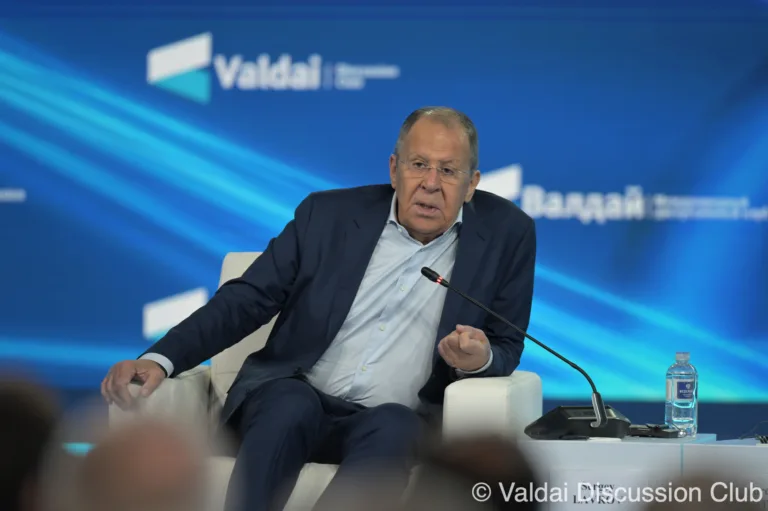

The former vice-president of the New Development Bank (NDB), also known as the Brics Bank, Paulo Nogueira Batista Jr., is in Russia to attend the 22nd annual meeting of the Valdai Discussion Club, held in the city of Sochi, which began on September 29 and concludes this Thursday (3).
The economist, who also served as executive director at the International Monetary Fund (IMF) for Brazil and other countries from 2007 to 2015, is one of the forum participants and granted an exclusive interview to BdF, which is covering the event in Sochi. He spoke about the importance of the Valdai Club for discussions on the transformation of the international system, the decline of U.S. hegemony, the challenges of de-dollarization, and the role of the Brics in a new multipolar order.
Traditionally, Russian President Vladimir Putin closes the event with a keynote speech and discussion with Valdai members, which brings together academics, diplomats, and political actors around the central issues of the global agenda. This year’s theme is “The Polycentric World: Instructions for Use.”
BdF – The Valdai Club forum seeks to reflect on the current international political context. Considering that this year’s theme is “The Polycentric World,” what are your impressions of the discussions regarding multipolarity?
Paulo Nogueira Batista Jr. – This Valdai Club forum is very important, although it is practically unknown in the West and in Brazil. And why is it unknown? Because it is a Russian forum, and everything Russian today is stigmatized in the West. There is a true brainwashing in Europe, the U.S., and even in Brazil when it comes to anything from Russia. But this is a very important occasion to discuss global issues. For a foreigner coming here, and this is my third time, it is a way of having direct contact with the Russian perspective on the problems we all face.
For example, the multipolar world: this is the world we are heading toward, or in fact, we have already arrived there. The era of uncontested U.S. hegemony has passed, and we now live in a more multifaceted world. And what is the best place in the world to discuss this new multipolar world? Russia. Why? Because Russia is at the forefront of the struggle for multipolarity. It is not an easy struggle, and the Russians are paying a heavy price for being in the vanguard, as we know. Russia has every right to host a discussion of this nature because we do not really know where we are heading. There are several possible scenarios, and some were debated here.
So is the world already living under a multipolar order, or are we still in a transition, with systems clashing? And when we talk about this, we are talking about anti-hegemony. How do you see the position of U.S. hegemony? Is its decline a done deal, or is this still a moment of confrontation where it has claws to show?
The multipolar world is already here, but it is relatively recent. Until about 20 years ago, what prevailed was an order dominated by the West, and within the West, by the U.S., which created a certain structure and dictated terms, that is the reality. That scenario is over. Now we are in a multipolar world.
But are we moving toward another hegemony, perhaps one dominated by China? I don’t think so. China is increasingly important and will continue to be, but in my view it does not have the objective conditions to entirely replace the U.S. The more likely scenario is one where you have the U.S. as an important pole, Europe as a privileged periphery, China, Russia, and hopefully Brazil as well. India too.
Brazil has the objective conditions to be one of these important poles in a multipolar world. However, it will need to overcome a difficult obstacle: the mental underdevelopment of Brazilians. Brazilians, in general, are intellectually colonized by Americans and cannot perceive their own potential. If it depends on part of the Brazilian elite, colonial to the core, Brazil will not be one of these poles.
But whether or not Brazil becomes an important pole, multipolarity will exist. And it is clear that the U.S. does not accept this and is trying by force to prevent it. But this force will not succeed. The U.S. and Europe will have to accept that, although they will remain important, the centuries-long period in which they exploited the rest of the world is over, or nearly over. As Putin once said: the “vampires’ ball” is ending. They can no longer exploit without firm, even furious, resistance.
You mentioned the different approaches within the Brics, particularly between Brazil and India on one side and Russia under sanctions on the other. Given US tariff threats and pressure, do you see a stronger inclination for BRICS countries to draw closer together?
Involuntarily, the Americans are helping to unite the Brics. Why? Because the U.S. is attacking indiscriminately, hitting not only adversaries but traditional allies. For instance, India, which within the Brics had been a dissenting force, closely aligned with the U.S. Indians believed they had a special relationship with Washington. Then Trump came and said: “No, you will only have access to my market if you subordinate yourself and stop buying Russian oil.” India said no. So, they were hit with a 50% tariff.
I often say in Brazil that we should thank Trump “comrade Trump, thank you” (laughs). That’s why Lula treated him so well when they had that 30-second meeting in New York, because Trump keeps shooting himself in the foot. He is, in himself, an expression of U.S. decline.
Look, I have been following the U.S. systematically since the 1970s. I have never seen the U.S. under such an incompetent, amateurish, and unprepared government as the one led by Donald Trump. It is unbelievable. And yet they elected him not once, but twice. They handed over both houses of Congress to his party. And this elected president is undermining what little democracy remains in the U.S.. He does not respect the law, the Constitution, or international law. It is a completely new world we are living in.
Do you think Russia seeks to use this moment to gain more support from countries like Brazil and India, taking advantage of this US approach?
Without a doubt. The West, led by the U.S., tried to isolate Russia, but Russia did not allow itself to be isolated. They failed. About 15% of the planet’s population, the so-called ‘political West’, sought to isolate Russia, but the Global South did not follow, with few exceptions.
So today we face a new reality: the 15% that used to dominate the world no longer has the same control. The 85% no longer accepts orders from the global minority. The global majority wants to follow its own path. It’s a difficult and winding path, but it is not one of subordination. And this message is being repeated again and again, though the US and Europe pretend they are not hearing it.
When we talk about a multipolar world, the issue of de-dollarization always arises. How do you see this debate today? Is it still stalled or moving forward? And is progress systemic or mostly bilateral?
The de-dollarization agenda is not in full swing. It is advancing, though more slowly than I would like. It is progressing mostly at the bilateral level, with countries trading in their national currencies. There are swap agreements led by China’s central bank as an alternative to Western balance-of-payments support mechanisms.
Countries, after what was done with Russian reserves, are diversifying away from the dollar and the euro: buying gold, for example, which explains the explosion in gold prices. So yes, there is movement toward de-dollarization.
But what is missing, in my view, is plurilateral coordination, which could be done within the BRICS, but has not yet materialized. There are many obstacles I cannot detail here, but basically, the path of least resistance would be to deepen mechanisms of transaction without the dollar or euro, using national or digital currencies. At a second stage, create a new reserve currency.
What many people fail to understand, even economists, is that transactions in national currencies have limits and amount to a kind of barter. That’s why money has existed for millennia. A currency is necessary not only as a medium of exchange but also as a store of reserves, because payments between different agents across countries are not synchronized. You need a general equivalent—a currency. Today, that general equivalent is the dollar. But the dollar is problematic, and we should be creating another general equivalent, which could be the long-discussed Brics currency.
From the discussions here at Valdai, how do you see the approach to the war in Ukraine? On one hand, Russia needs to resolve the conflict to advance its economic and foreign policy agenda for multipolarity; on the other, it faces permanent confrontation with the West. How is this being discussed?
Of course, the conflict, the war in Ukraine, is Russia’s main international policy issue. There is no doubt. It is their number one priority. They would like to resolve it, to end the war, but not at any cost. Because they are, as far as I can see, gaining advantages on the battlefield, and they have made very clear what conditions they would like to see met in order to achieve peace and settle the Ukraine issue. This has already been clarified. It is the West that refuses to listen.