At 7 p.m., the sun sets behind Haiti’s mountainous horizon and darkness falls instantly. Whether in rural villages or in the capital, public lighting is scarce or non-existent. In the dark, people retreat into their homes while only a few kiosks, bars, or food stands keep faint lights on for a few hours, keeping public life alive.
But it’s not just the absence of street lighting, it’s the absence of electricity itself. Haiti enters the first quarter of the 21st century with most of its population living without access to power. That means the majority of households have no refrigerators or washing machines; water access is precarious; schools operate without fans in the tropical heat; remote work is impossible; television never became a mass medium; and even something as simple as drinking a cold beer at night is out of reach.
In Port-au-Prince, the situation was slightly better until five months ago, when the public energy grid provided a few hours of service per day, just enough to charge phones or run a refrigerator. That system was powered by a plant in Mirebalais, a city where, since April, gangs have unleashed extreme violence. In protest against insecurity, residents stormed and shut down the power plant themselves. Their demands went unanswered, leaving the population, the victims of violence, also without power.
Abandoned infrastructure
In the rural town of Ranquitte, in northern Haiti, utility poles stand as reminders of a system that once worked. “We used to have light, power was running inside our homes,” recalled a local pastor who preferred not to be identified. “About three years ago it started failing, then stopped altogether. It never came back.”
Ranquitte was supplied by the Saint Raphaël power plant, inaugurated in May 2021 during the presidency of Jovenel Moïse. Beyond that inauguration, little information is available about the plant, and no reports in the national press explain its shutdown. Locals say that after Moïse’s assassination in July 2021, the plant, like much of the state apparatus, fell into neglect.
The Saint Raphaël case mirrors what is happening across Haiti: facilities exist, but power plants remain idle with no plan for reactivation even in regions untouched by gang violence. Moïse had made universal electricity access a central campaign promise, but after his death, successive governments abandoned the goal.
Still, the country’s energy crisis predates today’s political instability. Analysts point to decades of state capture by an elite uninterested in development. “The state has no plan to guarantee 24-hour electricity,” journalist Reyneld Sanon told BdF from Port-au-Prince. Instead, he explained, private energy contracts have become vehicles for corruption. “Often, the owner of a power company is a friend of whoever is in government, or the politician is a shareholder. When the state lets a public plant collapse, it enriches the private sector.”
Private power, public inequality
The result is stark inequality. In elite neighborhoods, embassies, luxury hotels, and government buildings, diesel generators and advanced solar systems maintain an appearance of normality. Just a few kilometers away, children pump water by hand from wells.
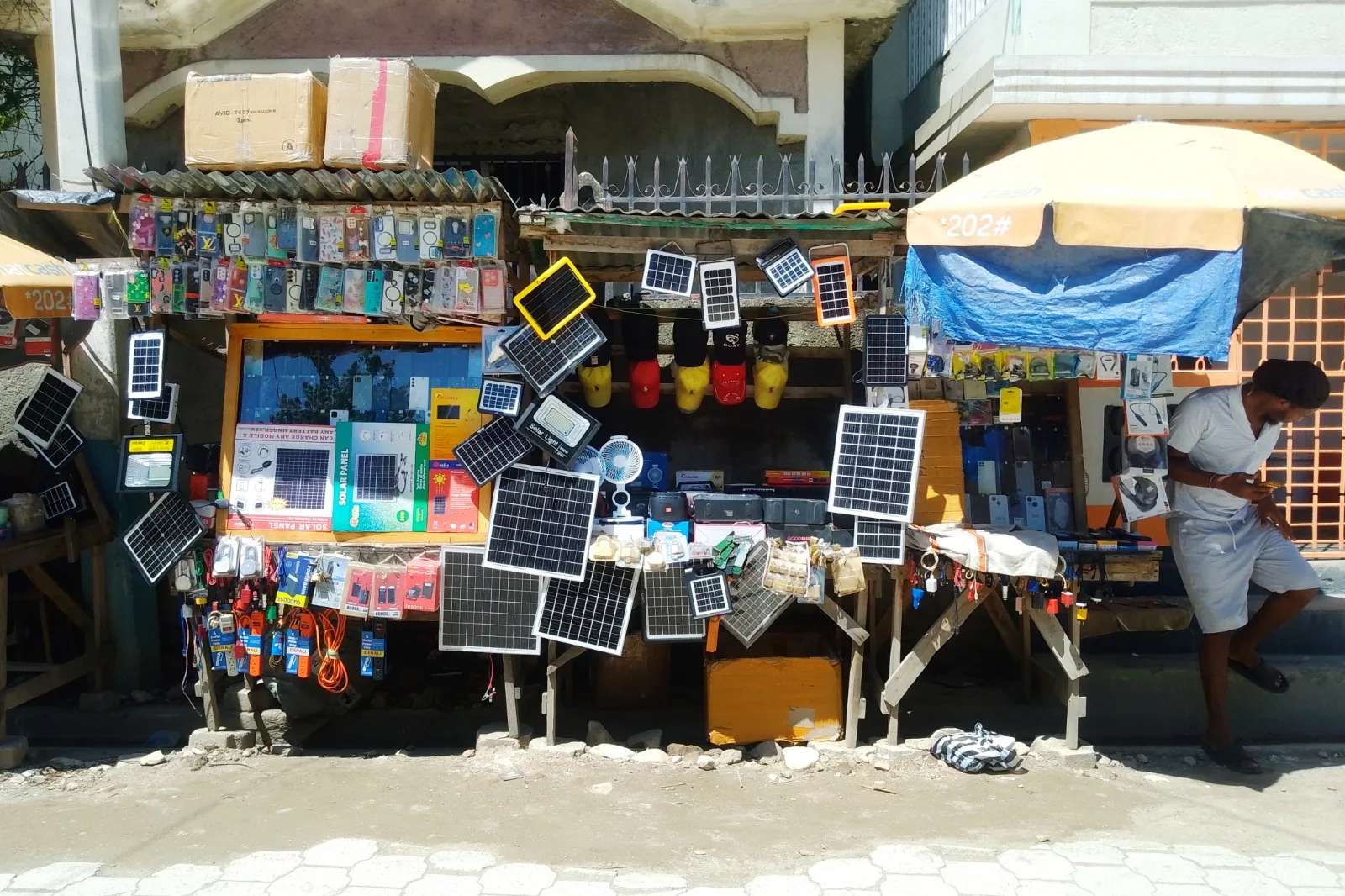
Street vendors in working-class neighborhoods sell makeshift imported devices: cheap solar lamps, rechargeable bulbs, portable panels of dubious durability. Small shops offer phone charging services for a fee, as mobile internet coverage remains surprisingly widespread thanks to solar-powered antennas.
For most families, gaining access to a reliable power supply that supports basic appliances is a sign of social mobility. In some urban centers, multinational companies have secured contracts to distribute energy through concessions. But across most of the country, the only option is private solar installation, an investment of about US$1,000 for a simple home, and up to 20 times more for schools, hospitals, or cultural centers.
Behind this reality, suppliers and importers of solar equipment profit, while Haiti’s dream of a sovereign state capable of ensuring basic services for its people slips further away.