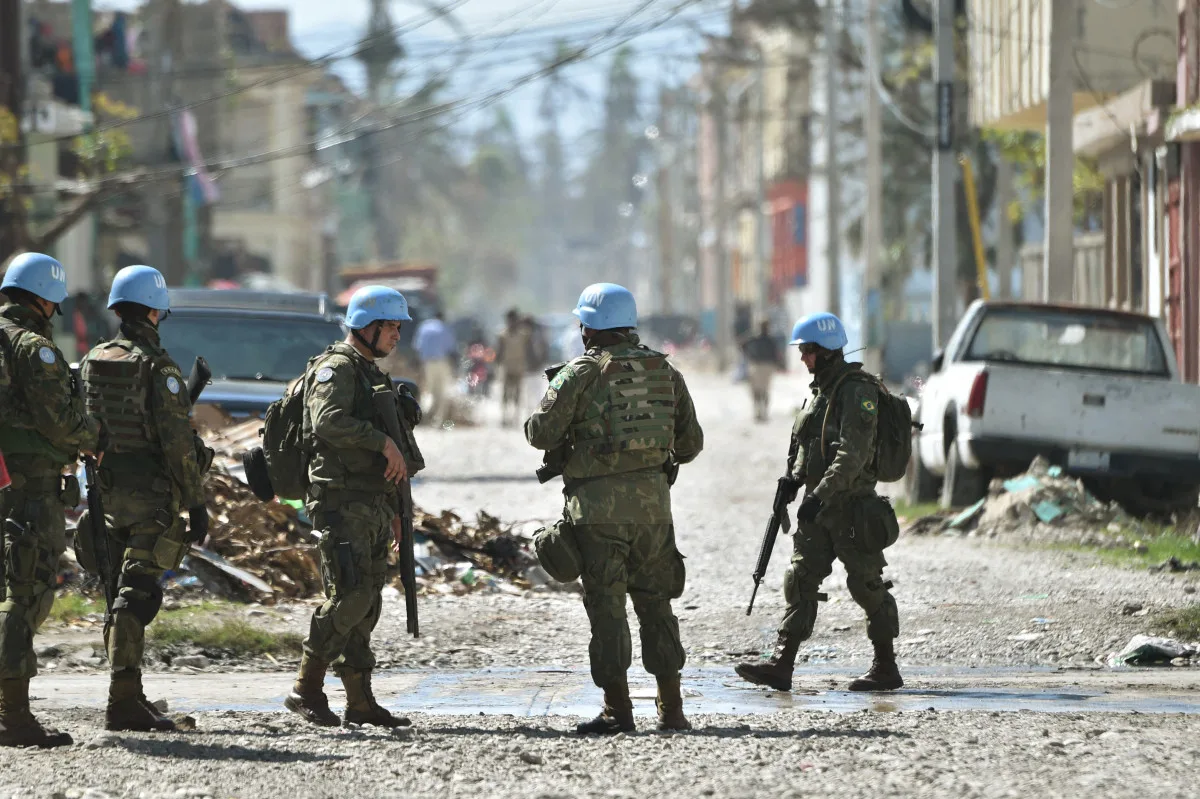
A peanut butter sandwich. That’s what lured 16-year-old Janila Jean toward a Brazilian soldier from the United Nations mission in Haiti, known as Minustah. The rape that followed not only took her virginity but also left her pregnant. The Brazilian soldier was never seen in the area again.
Stories like hers have been widely documented over the past two decades. During its 13 years of operations (2004 – 2017), the United Nations Stabilization Mission in Haiti (Minustah) – led by Brazilian commanders – left behind a deeply troubling legacy of violence, disease, and sexual abuse.
Marking eight years since the end of the mission this Wednesday (15), BdF revisits the story of the Brazilian soldiers’ abandoned children in Haiti – a dark and unresolved chapter of Brazil’s foreign policy.
There are no official estimates, but a major 2019 study by researchers Sabine Lee (University of Birmingham, UK) and Susan Bartels (OntarioUniversity, Canada), published on The Conversation, interviewed 2,500 Haitian women and identified 265 children fathered by UN “peacekeepers.” Of those, 21% – or 53 children – were born to Brazilian soldiers.
The cases often involved coercion, abuse, or, when not outright rape, small “exchanges” such as food or cash – sometimes just a sandwich – in return for sex. Many of the victims were teenagers or even children. Importantly, under UN peacekeeping rules, military personnel are strictly prohibited from engaging in sexual relations with the civilian population.
Intentional concealment
Brazil led the mission throughout its 13 years, sending 37,449 soldiers – more than any other country. The first commander was General Augusto Heleno, who in 2024 was sentenced to 21 years in prison in Brazil for his role in attempting a coup d’état. Allegations of sexual abuse were consistently denied by both the Brazilian military and the UN.
Only 52 investigations ever reached Brazil’s military justice system – 50 police inquiries and two cases of flagrant misconduct. None related to sexual violence. Of those investigations, 76% were closed without accountability for misconduct, and the remaining 24% were concluded without confirming any crimes. Nearly 40 of these cases involved violent offenses such as assault or homicide – yet none were recorded as sexual exploitation or abuse.
According to Fernanda Cavalcante de Barros, a researcher at Ruhr University in Germany, these figures suggest either that “Brazilian peacekeeping troops were impeccably following UN standards of conduct, or that serious misconduct was not being reported to Brazilian authorities, and even when it was, inquiries were not opened.”
After reviewing extensive evidence, Barros concludes it is clear that “the Brazilian government has concealed information about sexual abuses committed by its troops to maintain a ‘good image’ internationally.”
‘Just for show’
“What’s surprising is not that abuses happened – they always happen when UN soldiers are deployed abroad, because they enjoy immunity and face little oversight. The surprise is that nothing happened after the allegations,” said Ricardo Seitenfus, professor of international relations and author of The UN and the Cholera Epidemic in Haiti.
“Everyone knew what was happening – the UN, the Brazilian Army, which, as the mission’s leader, was responsible for investigating complaints against troops from other countries,” Seitenfus told BdF.
Among the many cases covered up was that of 134 Sri Lankan soldiers who allegedly sexually abused nine Haitian girls between 2004 and 2007. The case came to light only after an Associated Press investigation in 2017. The Sri Lankan government repatriated 114 accused soldiers and promised to investigate, but none were prosecuted.
Worse still, in 2011, a video circulated showing the rape of an 18-year-old Haitian man by six Uruguayan soldiers. The victim traveled to Uruguay to testify, but the following year, Uruguayan courts decided not to prosecute the perpetrators, who had filmed and shared the assault online.
“The flood of scandals forced the UN to create an unprecedented victims’ reporting office,” Seitenfus explained. “But since almost all victims were poor and needed lawyers to substantiate their claims, nothing came of it. It was just for show – for the record only.”
Haiti remains a hotbed of uninvestigated crimes committed by foreign forces. One of the most notorious examples is the Cité Soleil massacre of July 2005, under the command of then-General Heleno. The operation was meant to kill a gang leader, but according to a Reuters report, more than 70 civilians – many of them women and children – were killed.
Grassroots assistance
Another barrier to justice is Haiti’s own fragile legal system. Rape was only criminalized in 2005, and even then without a clear written definition – leaving it up to judges and prosecutors to decide what constitutes a crime. Complaints are accepted only if supported by a medical certificate, and survivors face retaliation, stigma, and extreme power imbalances. The result is severe underreporting, compounded by resistance within the UN itself.
In 2018, the Bureau des Avocats Internationaux (BAI) filed paternity lawsuits in Haiti on behalf of ten children allegedly fathered by UN peacekeepers. But the UN refused to cooperate, withholding crucial information and hindering progress in local courts. Lawyers from the Institute for Justice and Democracy in Haiti, which works alongside BAI, said the organization’s lack of cooperation forced poor Haitian women to shoulder the burden of proof – deepening their vulnerability.
One group that assisted BAI was Moleghaf (the Black Alliance for Freedom), a grassroots movement fighting abuses committed by foreign occupations in Haiti. One of its members, David Oxygène, has lived in Brazil for the past three years.
Speaking to BdF, Oxygène said Moleghaf provides assistance in Port-au-Prince to 40 to 50 single mothers abandoned with children fathered by Minustah soldiers – most of them Brazilians.
“Brazilian soldiers left children behind in Haiti – it’s a disgrace,” he said. “Whether in Haiti or Brazil, the law forbids that. Forcing sex or exchanging it for small favors is unacceptable. These women are extremely poor and vulnerable to soldiers who took advantage of them.”
“We try to raise awareness, report cases, and speak with authorities, but it doesn’t change much. They remain alone, without support from the fathers of their children.”
When asked if the Brazilian-led mission brought any benefit to Haiti, Oxygène was categorical: “An occupying force never brings anything positive. It exists to oppress, to stop the people from organizing, from deciding their own present and future.”
“MINUSTAH imposed on us the far-right government of Michel Martelly (2011–2016), the ‘Bolsonaro of Haiti.’ Soldiers under General Heleno massacred many Haitians in the slums – not just the poor, but also political activists.”
“There are the children of Brazilian soldiers, abandoned and living in misery – and then there’s the cholera epidemic, brought by MINUSTAH’s Nepalese troops, which still plagues us today,” he said.
“Ongoing occupation forces exist to keep Haiti on its knees, subjugated.”
*Reporting contributed by Cha Dafol in Haiti.