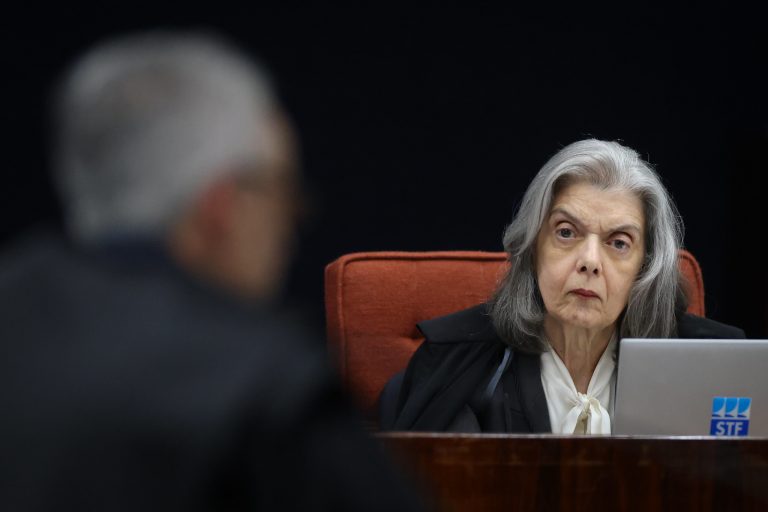
Brazil’s Supreme Federal Court (STF) formed a majority on Tuesday (21) to convict seven members of the so-called “fourth core” involved in the attempted coup d’état in Brazil. By a 3–1 vote, the justices found that this group was responsible for spreading false information about the 2022 elections and using the structure of the Brazilian Intelligence Agency (Abin) to spy on political opponents.
Justice Cármen Lúcia cast the vote that consolidated the majority, siding with rapporteur Alexandre de Moraes and Justice Cristiano Zanin. They ruled that the defendants committed the crimes of attempted violent abolition of the democratic rule of law, coup d’état, armed criminal organization, qualified damage, and deterioration of protected public property. The only dissenting vote came from Luiz Fux, who argued for the dismissal of the charges brought by the Attorney General’s Office (PGR).
The last vote will come from the panel’s president, Justice Flávio Dino.
The convicted members of the “fourth core” are former Army major Ailton Moraes Barros; reserve major Ângelo Denicoli; Carlos Cesar Moretzsohn Rocha, president of the Legal Vote Institute (IVL); sub-lieutenant Giancarlo Rodrigues; lieutenant colonel Guilherme Almeida; Federal Police agent Marcelo Bormevet; and Army colonel Reginaldo Abreu.
The trials of those involved in the January 8, 2023 attacks on Brasília’s institutions were divided into several groups (“cores”) based on their specific roles in the coup attempt.
Votes in favor
In her vote, Justice Cármen Lúcia stated that democracy depends on trust and upheld the evidence presented by federal prosecutors. She said the conviction was based on documents produced by the defendants themselves, which clearly showed their participation.
“Both the crimes of armed criminal organization and the attempted violent abolition of the State were proven through the documented acts. The evidence of qualified damage and deterioration of protected property is also abundant and well-substantiated,” she said.
Justice Alexandre de Moraes, who opened the vote, argued that the group had organized a disinformation network to discredit democratic institutions, using “freedom of expression” as a false pretext.
“It is an absurd, criminal, and anti-democratic lie to say that attacking the Electoral Court, the Judiciary, and democracy itself is freedom of expression. This is a crime, clearly typified in the Penal Code,” Moraes stated.
He also criticized big tech companies for serving as platforms that amplified hate speech during the coup efforts.
Justice Cristiano Zanin also sided with Moraes, stating that there was clear coordination among the groups to promote disinformation and pressure the Armed Forces into an institutional rupture.
Voted against
Justice Luiz Fux, following his position in previous trials of the “hard core,” voted against conviction. He argued that “mere planning” or intention to stage a coup cannot be considered a punishable act.
“No one can be punished for mere cogitation. Preparatory acts do not attract criminal liability. The interpreter of the law must not equate preparation with execution,” Fux said.
According to him, there was no conclusive evidence that Abin’s parallel intelligence structure directly participated in the crimes.
Other trials
Earlier this year, the First Panel of the Supreme Court sentenced former president Jair Bolsonaro to 27 years and 3 months in prison for leading a criminal organization, attempting to overthrow the democratic state, and plotting a coup.
Seven other defendants linked to the political and military branches of the coup plot were also convicted, including former Defense Minister Walter Braga Netto and Bolsonaro’s former aide Mauro Cid, who received a reduced sentence after entering a plea agreement. Justice Luiz Fux was again the sole dissenting vote, advocating the acquittal of Bolsonaro and some co-defendants.
The STF will reconvene on Wednesday (22) for Justice Flávio Dino’s vote. The Court is also reviewing the other three cores involved in the January 8 coup attempt. So far, the “hard core,” which included Bolsonaro, was concluded in September; the “third core” will be tried in November, and the “second core” in December.