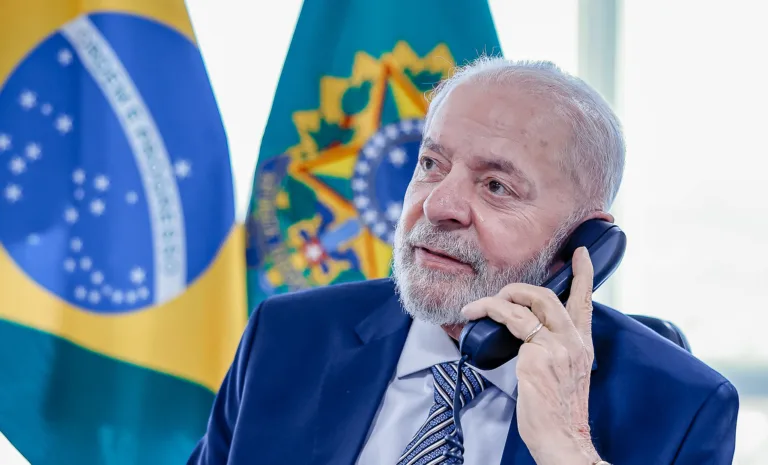

President Luiz Inácio Lula da Silva said on Thursday (23) that he will run in the 2026 elections, seeking a fourth presidential term. The announcement was made in Jakarta during a press conference alongside Indonesia’s president, Prabowo Subianto. The two leaders signed several agreements and established strategic partnerships. Subianto said he admired Lula’s programs for the Brazilian people.
“I want to tell you that I will soon turn 80, but you can be sure I have the same energy I had at 30. And I will run for a fourth term in Brazil,” Lula said. “I’m telling you, we’ll still meet many times. My current term ends only in late 2026, but I’m ready to run in future elections,” he added.
The Brazilian president will also meet with local business leaders and sign bilateral trade agreements during the Brazil–Indonesia Economic Forum. “It is with great joy, hope, and determination that I am here to ensure that the Indonesia–Brazil relationship becomes increasingly productive and beneficial for our peoples,” Lula said.
Criticism of Trump
During his speech, Lula criticized protectionist trade measures and defended the idea that countries should be able to conduct commercial transactions without relying on the U.S. dollar as a reference currency, though he did not mention U.S. President Donald Trump by name.
“We want multilateralism, not unilateralism. We want trade democracy, not protectionism. We want to grow and create jobs, quality jobs, because that’s why we were elected to represent our people,” Lula said.
The Brazilian president is scheduled to meet with Trump next Sunday (26) to discuss the tariff hikes and bilateral relations between Brazil and the United States. One of the measures Trump has criticized in relations with Brazil is precisely the proposal for a new trade currency, an idea advanced within the Brics group, comprising Brazil, Russia, India, China, and South Africa, along with newly associated countries.
Lula once again defended the possibility of transactions in national currencies, without mentioning the dollar. “Both Indonesia and Brazil are interested in discussing the possibility of trading in our own currencies. This is something we need to change. The 21st century requires the courage we lacked in the 20th. It demands that we change our commercial practices so we are no longer dependent on anyone.”
Lula is on a state visit to Indonesia and will then travel to Kuala Lumpur, Malaysia, to attend the 47th summit of the Association of Southeast Asian Nations (Asean). He is expected to return to Brazil next Tuesday (28).
Read Lula’s full speech
It is a great honor to participate in this Economic Forum accompanied by ministers and more than a hundred Brazilian business leaders.
When I first visited Indonesia 17 years ago, the world was going through the 2008 financial collapse. The neoliberal playbook proved incapable of containing the turbulence generated in the developed world. Brazil demonstrated that it was possible to grow without giving up social inclusion and well-being. We bet on our domestic market and diversified our trade partnerships, emerging stronger from the crisis. That year, I toured Southeast Asia and came to Jakarta with a large delegation of private-sector representatives.
We established with Indonesia Brazil’s first strategic partnership within Asean, which was already one of the most dynamic growth hubs in the world. Since then, our bilateral trade has increased from US$2.2 billion to US$6.3 billion in 2024. We have made significant progress, but these figures remain far below the ambitions of our Strategic Partnership and our cooperation within Brics.
Our trade exchange still falls short of its potential, as our countries together represent half a billion people. Indonesia is already the fifth-largest market for Brazil’s agribusiness exports and an important destination for soy, sugar, wheat, corn, and coffee. We can contribute to Indonesia’s food security, including President Prabowo’s “Free Nutritious Meal” school feeding program.
Working to facilitate trade and lower costs for end consumers is a commitment I share with President Subianto. Brazilian industry is also competitive in several high-tech, high–value-added sectors, such as aerospace and defense. The Defense Cooperation Agreement, which entered into force in March this year, opens the door to broader partnerships. Indonesia’s Air Force is well acquainted with the capabilities of the Super Tucano aircraft. Brazilian civil aviation also offers the best solutions for regional airlines, efficient, fuel-saving, and technologically advanced.
Brazil does not seek merely to sell to Indonesia. Brazilian imports have grown in recent years, particularly of palm oil, musical instruments, footwear, motorcycles, bicycles, and office machinery. We are betting on a balanced and mutually beneficial partnership. As two of the world’s largest bioenergy producers, we can work together to create a global biofuels market. The International Maritime Organization cannot indefinitely postpone its decision to decarbonize the shipping sector. Ethanol biofuel is a viable and immediately available alternative.
My friends, less than twenty days separate us from COP30. Quadrupling the use of sustainable fuels is one of the proposals we will take to Belém. We will show that it is possible to promote development, tackle climate change, and protect tropical forests and their rich biodiversity. Brazil is restoring 40 million hectares of degraded land. We can expand biofuel production without cutting down a single tree.
By hosting COP30 in the heart of the Amazon, Brazil seeks to show that it is impossible to protect nature without caring for the people. Indonesia’s support for the Tropical Forests Forever Fund has been crucial for its launch in Belém. Brazil has done its part, already announcing a US$1 billion contribution to the Fund. The TFFF generates dividends both for those who invest and for those who protect the biome, offering income alternatives to those who preserve the forest.
Although only 30% of our mineral wealth has been mapped, Brazil already holds 10% of the world’s critical mineral reserves, essential for the energy transition. The creation of a National Council for Critical Minerals, linked to the Presidency, will be an important step in ensuring sovereignty. Indonesia’s experience encouraging domestic mineral processing serves as an important model for attracting investment and generating quality jobs.
We do not intend to remain mere exporters of raw commodities. We want to add value domestically, with environmental responsibility and respect for local communities. We rely on Indonesia’s long-standing experience with Vale, which has operated nickel mines in Sulawesi since 1968. Indonesia, in turn, is already Asean’s third-largest investor in Brazil, with US$1.8 billion in investments across sectors such as sugar and ethanol, pulp and paper, tobacco, textiles, and port logistics.
My government is rebuilding the Brazilian state’s planning capacity and working to attract even more investment. The positive results achieved stem from a consistent effort to modernize regulations and encourage innovation and public-private partnerships. Last year, we passed a tax reform to correct historical distortions. Earlier this month, the House of Representatives approved income tax exemptions for those earning up to around US$1,000 per month, and a 10% increase for those earning more than US$100,000 per year.
Dear friends, Brazil maintains a universalist diplomatic tradition. We aim to continue expanding our relations with the world, without distinction or automatic alignments. Asean, with 680 million people, has seen rapid economic growth and technological progress. Its combined GDP of nearly US$4 trillion makes it the world’s fourth-largest economy, behind only the United States, China, and Japan.
Expanding the integration of our economies has proven to be the right choice. In December 2023, during Brazil’s last presidency of Mercosur, we concluded a trade agreement with Singapore. During our current presidency, by the end of the year, we will advance negotiations toward a Preferential Trade Agreement between Mercosur and Indonesia. Within Brics, Brazil’s PIX and Indonesia’s QRIS offer effective, accessible payment systems that can inspire similar measures to facilitate local-currency trade among member countries.
This movement is also part of Brazil’s broader strategy to diversify partnerships and facilitate trade. Like Indonesia, Brazil opposes unilateral and coercive measures that distort commerce and limit economic integration. It is the private sector, through partnerships and joint projects, that will turn our diplomatic affinity into shared prosperity for our societies. Indonesia and Brazil will remain partners in building a future of cooperation, development, and social justice.
Thank you very much!