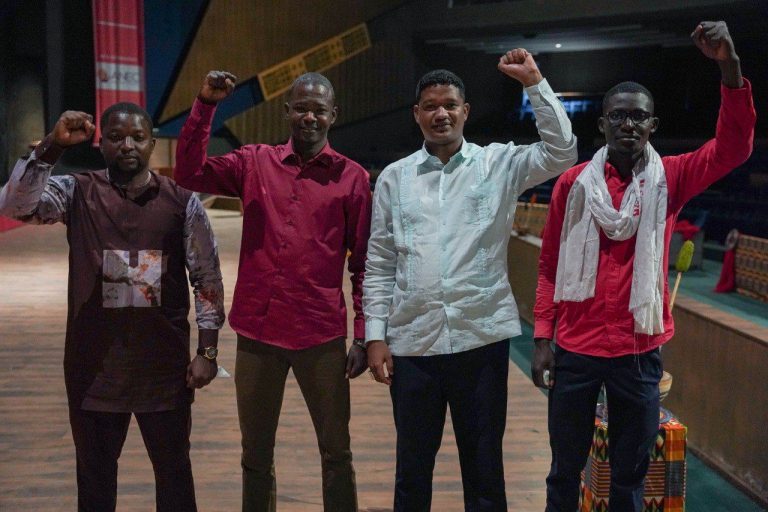
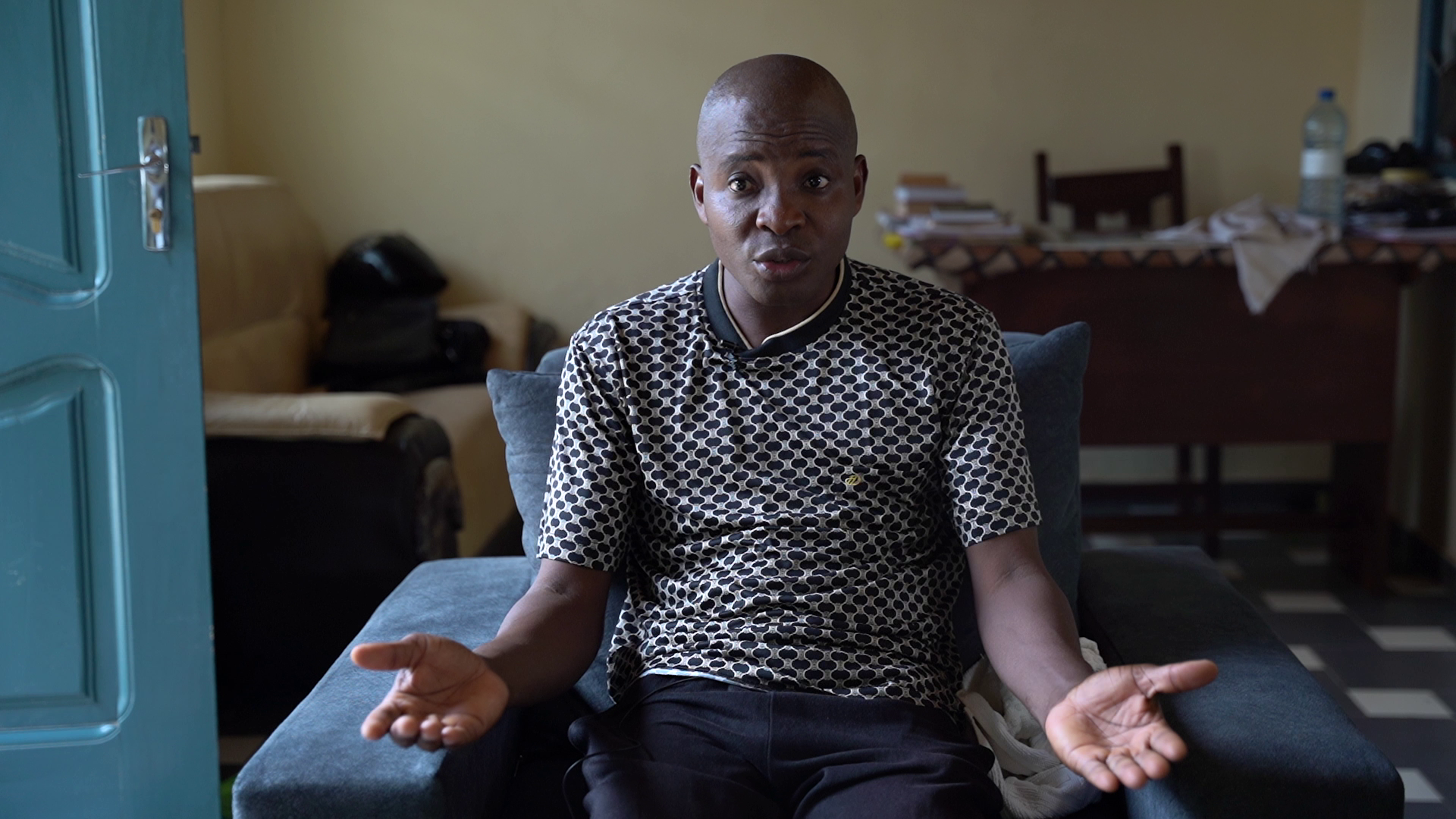
Activist and political leader Damien Zinsou Dégbé, president of the Council of Patriotic Youth (CoJeP) of Benin, the main organization coordinating demonstrations against the French military presence in the West African country, was kidnapped on October 21, 2025, by plainclothes agents in an unmarked vehicle.
The information was confirmed by the Organization for the Defense of Human and Peoples’ Rights (ODHP), which classified the episode as a “criminal act” and demanded his immediate release. Three days since his arrest, Dégbé remains in custody.
According to the ODHP, the young man was taken to the National Center for Digital Investigation (CNIN), headed by Ouanilo Mèdégan, a central figure in the repressive apparatus of President Patrice Talon’s regime, an ally of French President Emmanuel Macron in West Africa.
Interrogated during the night, Dégbé was charged with “cyberharassment, incitement to violence, and rebellion,” charges that, according to the organization, are exclusively politically motivated, based on his activities in the Communist Party of Benin (PCB) and his public criticism of the government.
After questioning, he was transferred to the police station in the port of Cotonou. A day later, on October 22, Parfait Gnami, a member of the CoJeP in the Parakou region in the north of the country, was also arrested.
According to the ODHP, the Talon regime has a history of kidnappings and arbitrary detentions inside and outside the country, including the cases of Steve Amoussou, Hugues Comlan Sossoukpè, and Reckya Madougou, which characterize a pattern of state terrorism.
In January, two members of the Patriotic Youth Council (CoJeP) were arrested. At the time, the young people were staging a peaceful demonstration in downtown Cotonou against the French military presence in the country.
“Benin is currently living under fascist methods of government that crush young people and citizens,” says the statement, which calls on the international community and democratic movements to press for their release.
Patrice Talon’s election, arrests, and political persecution
In April 2021, Benin’s electoral commission declared Patrice Talon the winner of the presidential election with 86% of the votes in the first round, in an election marked by a boycott by part of the opposition. On the eve of the vote, according to the organization Human Rights Without Frontiers International, two people were killed when troops opened fire to disperse an opposition protest blocking a major road in the city of Savè, in the center of the country.
The same report highlighted that, since coming to power in 2016, Talon has consolidated an increasingly repressive regime, arresting or forcing into exile most of his political opponents. These actions, coupled with control over the judiciary and the creation of special courts used against opponents, reinforce allegations of democratic weakening and political persecution in Benin.
From January to September 2021, according to the report, 200 individuals were arrested for political reasons, with most of them awaiting trial in pretrial detention. In 2021, Benin’s 11 prison facilities housed approximately 9,000 inmates, significantly exceeding the normative capacity of 5,620 inmates.
In July, three months before his arrest, Damien Dégbé gave an interview to BdF in Cotonou, Benin’s economic capital. In the conversation, the popular leader, who is now in prison, denounced the “autocratic and pro-imperialist” nature of Patrice Talon’s government, accusing the president of handing the country over to France and systematically repressing popular demonstrations.
“We strongly condemn what we call Patrice Talon’s ‘high treason,’ which allows former colonial aggressors to once again ‘drink champagne on the graves of our heroes who fought against the invaders. And that is why young people demand that he answer for his actions and promise to continue fighting for the complete liberation of the country from French hands, in favor of a new democratic and patriotic power,” said the leadership of the Council of Patriotic Youth (CoJeP) of Benin.
Dégbé also spoke about the presence of French troops in Benin and the movement to break with the West led by the countries that make up the Alliance of Sahel States (AES): Mali, Burkina Faso, and Niger.
“The new world that is emerging places human beings at the center of policies and concerns, unlike the old system commanded by American imperialism and armed by NATO [North Atlantic Treaty Organization], which turned man into a mere commodity. That old world is crumbling, and a new one is emerging. Therefore, the liberation of Africa is inevitable. With or without the consent of the old powers, Africa will liberate itself,” says Dégbé.
Check out the full interview
BdF: How would you characterize Patrice Talon’s government?
Damien Dégbé: Patrice Talon’s power is within a consolidated neoliberal government that succeeds other powers that maintain neocolonialism in our country. When you look at all of its policies, economic policy, infrastructure construction policy, educational policy, we see this clearly. For example, the creation of a purely French school here in Benin, which opened its doors last October called the Manuel Talon school, and which uses only a typically French program and even a typically French academic calendar.
Another example is his health policy, which consists of destroying the national public heritage for the benefit of what the powers, French imperialism, impose on him. I take as an example the newly installed hospital called “Chic,” which is nothing more than a purely French center exported here, run by French expatriates.
And the worst thing is that, in the clauses for the installation of this hospital, it is stipulated that it will be tax-exempt for 17 years. For 17 years, it is the masses here who will pay: it is the citizens who will pay for the electricity and water for this hospital, while expatriates come here, exploit the country’s economy for free, and pay no taxes. These are some illustrations of what Patrice Talon’s power represents from the point of view of the country’s sovereignty. He has practically liquidated the country.
Every day, or practically every week, young people are in the streets. Women are in the markets. Peasants and producers, who are harassed, exploited, deprived of the fruits of their labor, overburdened with unfair taxes and fees, and prevented from enjoying the results of their production, all these groups, now united around the CoJeP, are standing up and saying “enough is enough,” demanding an end to the autocratic and pro-imperialist regime of Patrice Talon, and fighting for a new democratic and truly patriotic governance in the country.
On Friday, June 13, demonstrations were held in three different locations across the country, organized by local committees of the Patriotic Youth Council, and they were also a success. We saw women and young people full of energy, ready to fight against poverty and, above all, against the authoritarianism represented by Patrice Talon’s power. These demonstrations demonstrated the determination of our people and had a major impact both inside and outside the country.
As usual, the autocratic regime reacted: the next day, Saturday, June 14, two women who had participated in the demonstration at the market in Parakou, a city located in the north-central part of the country, were arrested, along with a CoJeP leader. All were detained at the police station in the first district of Parakou. Since then, denunciations and mobilizations demanding their release have continued, as well as the continuation of the struggles with clear demands: no to the harassment of peasants and producers, no to unfair taxes and fees, no to the presence of French troops in the country.
We strongly condemn what we call Patrice Talon’s “high treason,” which allows former colonial aggressors to once again “drink champagne on the graves of our heroes who fought against the invaders.” That is why young people demand that he answer for his actions and promise to continue fighting for the complete liberation of the country from French hands, in favor of a new democratic and patriotic power.
Damien, can you tell us a little about your history and how the Patriotic Youth Council of Benin (CoJeP) came about?
I joined the struggle while still in high school, as a leader of the National Union of Students and Schoolchildren of Benin (UNSEB). Later, at university, I was secretary-general of the organization. Later, I sought political training and joined the Communist Party of Benin, which educated me ideologically. It is under this guidance that we created the Patriotic Youth Council (CoJep), and it is in this spirit that we remain steadfast.
CoJep was born on March 29, 2021, with representatives of democratic and patriotic youth from all departments of the country. On that same day, we adopted a manifesto that diagnosed the national context: a moment marked by the massive rejection of the people of the autocratic and pro-imperialist power of Patrice Talon, supported by the boots of French imperialism.
Young people, faced with unemployment, underemployment, and above all, the precariousness of life, decided to take responsibility and found CoJeP, which has since advanced in its trajectory.
Women and young people seem to be at the forefront of these mobilizations. Why?
In fact, it is young people and women who feel this misery and hunger more strongly than any other group in the population. First, because it is young people who directly face the problem of unemployment.
Young people leave schools, universities, vocational training centers, and workshops with diplomas in hand, but remain unemployed, without work. This is the first great suffering of young people.
Secondly, women. Since the arrival of Patrice Talon’s autocratic regime in power in 2016, its anti-social policy has consisted of cutting jobs, laying off people, and expelling street vendors without offering any alternative for relocation.
In other words, all these workers, women, men, parents, children, have been removed from their activities, and the greatest burden has fallen on women, who have to work hard to ensure the survival of their households.
But, in addition to them, other segments of the population are also suffocating. Just look at what happens to peasants: they are persecuted, their paths are blocked with ditches and stones on the routes that lead to the borders with neighboring countries, all to prevent them from selling their products where the price is better.
An example: a soybean producer sees that, across the border, a kilo is selling for 1,000 francs, while in Benin it is worth only 400 francs. If he tries to cross the border to sell at a better price, he is repressed and forced to sell for 400 francs in his own country.
And when he does sell, the government, through its parallel structures, controlled directly by Patrice Talon, who holds a monopoly on all these tropical products, buys his production at low prices. Part of it is “transformed” in an industry based in Glodjigbé, called GDIZ, which is actually a form of relocation of industries from imperialist countries to Benin. Then, businessmen export the rest abroad, where they sell at very high prices, while rural producers continue to live in precarious conditions and poverty.
Therefore, the poverty and hunger that plague the country today are not only felt by young people and women, but by the entire Beninese population, who suffer and complain about this widespread situation of injustice and impoverishment.
You mentioned the regional context, with the changes observed in the countries that make up the Alliance of Sahel States (AES). What is the impact of this process on Benin?
As is no secret, there is currently a rising tide of African patriotism in the West African sub-region. Take, for example, what is happening in Burkina Faso, with the military takeover led by Ibrahim Traoré; what is happening in Mali with Assimi Goïta; and what is happening in Niger with General Abdourahmane Tchiani.
All these actors have learned lessons from the damage France has caused to their countries, hiding behind the false fight against terrorism, and have taken responsibility by expelling French troops from their territory. The most recent was Niger.
Then Patrice Talon signed a new military agreement with Emmanuel Macron at the Élysée Palace to allocate part of the troops expelled from Niger here. And, as you know, when French troops move somewhere, they always bring with them the terrorism that they themselves manufacture, maintain, finance, and arm to attack populations and countries.
It is in the name of the fight against this supposed aggression that these troops are stationed and operate, with the aim of using Benin as a rear base to attack countries in the Sahel and reposition themselves.
This is therefore the role that Patrice Talon plays today: he serves the interests of France and works against the interests of the Beninese people. That is why the youth of Benin are saying “enough is enough.” We must take responsibility.
If you could talk a little about the number of 500 French soldiers who are living in Benin today. Even if Talon and Macron deny this number, it is something that you denounce a lot…
There are 500 French soldiers in Benin, and this number was not presented by chance, it is well documented. At the appropriate time, we will present these documents as proof. This fits in with the same logic I explained earlier: Talon handed the country over to France through a new military agreement he signed with Emmanuel Macron.
These soldiers are seen daily by the population, even while the government denies their presence, which confirms the manipulative nature of this power. A power that lies, manipulates, and does not take responsibility for its choices or its policies.
No one knows exactly what role French troops play here. And if they are really here to fight terrorism, why then does terrorism continue to grow? This is the question Beninese people are asking themselves today.
The conclusion is that they do not play any positive role; on the contrary, they are the ones who intensify the terrorist attacks in which our children, brothers, and fathers die every day. That is why the Beninese people are demanding that they leave the country and go home, because we want a free and sovereign territory.
Today, part of the national territory is occupied. More than six villages in the north of the country, especially in the department of Atakora, have been emptied. The men have fled, schools and hospitals have been closed, and these areas are occupied by whom? By the so-called “jihadists,” who are in fact auxiliary forces of the French army present on Beninese soil.
How is it possible to reach such a serious level of betrayal against one’s own people? We have seen what happened in the Sahel. Everyone knows that France has always been behind the terrorist groups in that region. Since the French left Kidal, Mali, the Malian regular army was finally able to retake the city, something that had not happened for almost nine years. It took Goïta’s arrival in power for Kidal to be liberated and for the Malian people to be able to live there again.
After the French troops left, it was discovered what they were really doing: a mineral exploitation scandal. There was gold, which the French extracted through underground tunnels, and oil, which they also exploited.
It is not a sin for us to be a rich people with underground resources, but what we are asking for is the right to enjoy our own wealth.
What does the growing anti-French sentiment in West Africa mean to you?
The sentiment we are talking about is not anti-French sentiment, but rather sentiment against French imperialism. Our struggle is not against the French people, who, incidentally, in many cases share the same causes as us. Our struggle is aimed at the French oligarchy, which holds both the French people and the African peoples hostage, exploiting them.
It is against this oligarchy that we rise up, and that is why we reject the term “anti-French sentiment.” No, what exists is an anti-French neocolonialist, anti-French imperialist, and anti-French oligarchic sentiment. That is what it is all about.
And that is exactly what the African peoples have been expressing in the streets when they say, “Enough is enough!” France has exploited our countries for too long. What the Alliance of Sahel States (AES) represents today for African peoples is a symbol of hope, because we see there a real patriotic movement with concrete actions: the French have been expelled, the Americans have been expelled, their troops have been withdrawn, after decades of presence without bringing anything positive.
Today, for example, Burkina Faso, a desert country that many believed incapable of feeding itself, is producing enough to supply even its more arid neighbors. This is seen as progress, an upswing, and that is why this alliance represents real hope.
We believe this is a historic and inevitable movement, because Africans are no longer willing to serve as cannon fodder for their former masters.
In French-speaking African countries, the main concern now is to free themselves from the tutelage of French imperialism. That is what we are fighting for. That is why we are allied with the AES. And that is why the African peoples concretely support these three Sahel countries.
We see this in recent demonstrations in various parts of the continent. For example, when messages circulated about an alleged plan to assassinate Burkinabe President Ibrahim Traoré, the popular reaction was not limited to Burkina Faso. All of Africa rose up as one: French-speaking, English-speaking, Portuguese-speaking, Spanish-speaking, and even German-speaking Africa, not to mention the African diaspora in Europe, America, and Asia. Everyone stood up to say, “This time, Africa will win.”
The Sahel has become a beacon for all of Africa, and the entire continent stands in solidarity with the three AES countries. To say that we are now experiencing true African independence would perhaps be an exaggeration, because independence is a process. What is happening now is a war of independence. Full independence has not yet been achieved. We can only speak of true independence when we win this war, a war also waged through manipulated terrorism.
But this true independence is inevitable, because the mistake of the false independence of 1958-1960, when white colonizers were replaced by black “settlers,” will not be repeated.
Today, the paradigm has changed. There is no longer any room for traitors or Black-skinned “settlers.” This is an irreversible movement. It may take as long as it takes, but it will ultimately triumph because the world is changing. And this transformation brings new values based on humanism.
This humanism, we affirm, is first and foremost African, first and foremost black. There is no reason why it should not triumph here.
The new world that is emerging places human beings at the center of politics and concerns, unlike the old system commanded by American imperialism and armed by NATO, which turned man into a mere commodity. That old world is crumbling, and a new one is emerging. Therefore, the liberation of Africa is inevitable.
With or without the consent of the old powers, Africa will free itself. Unlike what happened in the two world wars, when Africa fought under the command of foreign powers, today Africans exist, claim their identity, express it, and assume it.
Africa will no longer serve as cannon fodder for anyone. It will take advantage of the wind of global change to achieve, once and for all, its true independence.