
China’s control over 90% of the world’s rare earth minerals, combined with a policy of “strict reciprocity”, are among the decisive factors that pushed the Trump administration to accept mutual suspensions of tariffs and export controls during the meeting between Xi Jinping and Donald Trump in Busan, South Korea, on Thursday (30). The technical agreements, previously negotiated in Kuala Lumpur by diplomatic teams from both countries, reveal not only a tactical easing of U.S.–China tensions but also Washington’s race against time to reduce its dependency on China for critical minerals.
“This is China’s ace up its sleeve. It can inflict immediate damage,” says Li Bo, president of the Chunqiu Institute for Development and Strategic Studies in Shanghai, in an interview with BdF, referring to China’s export controls on rare earth–related technologies announced on 9 October in response to U.S. sanctions. Rare earth minerals are essential for the military and semiconductor industries, and China dominates not only extraction, but, above all, the processing technologies linked to these materials.
“[The export controls on rare-earth-related technologies] really forced [the U.S.] to sit at the table, talk, and suspend tariffs. Within a year they may make some progress. And then they may start tightening on China again,” Li Bo assesses.
“When dealing with trade issues with the U.S., the Chinese government’s core guiding principle is strict reciprocity,” explains Shen Yi, professor at Fudan University’s Brics Studies Center. “This means that if you impose a 10% tariff on me, I will certainly retaliate with 10%. I will not make a gesture or concede.”
This “eye for an eye” strategy, or strict reciprocity, worked. “Whatever you do, I will do as well. If you cooperate, I will cooperate; if you deceive or maneuver, I will also take equivalent retaliatory measures,” Shen Yi says.
“You sanction my chips, I sanction your rare earths; you sanction my chip industry, I impose full sanctions across the rare earth supply chain,” Shen Yi continues, describing Beijing’s approach.
After months of tariff escalation, with rates reaching as high as 145% on Chinese goods earlier this year, Trump accepted three temporary suspensions that take effect immediately.
Search for stability
Asked about Trump’s triumphant tone after the meeting, Professor Shen Yi says: “We are not particularly concerned with that, because our focus is on concrete actions between China and the U.S. and on maintaining a stable relationship.”
Regarding China’s strategic objectives, Li Bo explains: “Xi has already said the Earth is big enough. So, both countries can coexist, peaceful coexistence is China’s goal.”
However, he highlights two priorities: “One is a peaceful relationship with the United States, because it is still a superpower. We are not seeking victory in a hot war, that would destroy the world. But at the same time, the other priority is that we will defend our fundamental interests.”
Consensus is only the beginning
Shen Yi underlines the gap between reaching a consensus and implementing it: “Trump tends to present consensuses as if they were already resolved and underway. There is a major difference between the two [Xi and Trump]. Reaching a consensus is only the beginning.”
The professor argues that Trump needs this “victory narrative” for two reasons: “First, he must substantially ease relations with China because this is very important for U.S. capital markets and investor confidence today; at the same time, he must send a message abroad, especially to his supporters, that he is still a very tough Trump.”
For Li, there is no reason to trust the current U.S. president: “How can anyone take his words seriously? One day he says he will end the war in Ukraine because Ukraine ‘has run out of cards to play.’ The next day he says Russia’s economy is about to collapse.”
“Whatever happened, he needed to celebrate,” Li concludes.
Pausing the hardline approach?
Despite doubt, the prospect of reciprocal visits between the leaders could signal a considerable shift, Shen Yi notes. “In Chinese diplomacy, top leaders visiting each other’s country represents a very high level of diplomatic protocol, meaning that bilateral relations have entered a stable and healthy development path.”
He recalls that Trump’s visit to China in 2017 was the last by a U.S. president. Joe Biden did not visit China during his term. If Trump restarts such visits, “Trump will personally end the ten-year hardline era toward China that he himself initiated.”
This could benefit the U.S. president politically, Shen says: “If this easing deepens, since it was Trump himself who initiated this shift ,it will also be seen as one of his political achievements.”
A tense calm
Despite the prospect of détente, caution remains. “If no unforeseen factors intervene, during the remainder of Trump’s term, cautious optimism is possible,” Shen Yi assesses.
“But as a U.S. scholar realistically put it: China and the U.S. previously pointed all kinds of weapons at each other and began firing. Now they have stopped shooting and stopped aiming at each other, but the weapons have not been dismantled. They are simply there, in a state that could be reactivated at any moment,” he says.
“We must look at this summit with a very lucid, rational, and pragmatic attitude,” Shen concludes, summarizing China’s posture toward the Kuala Lumpur agreements and the Busan meeting.
The concrete agreements
The first concrete outcome eliminates the 10% tariff on Chinese imports linked to fentanyl, while the 24% retaliatory tariff remains suspended for one year for both sides. “China agreed to increase efforts to crack down on the so-called fentanyl flow into the U.S. And for that, the U.S. will reduce tariffs by 10% on imports from China,” Li Bo summarizes. China, in turn, cancels its retaliatory tariffs on U.S. products in the same category.
The second — and most strategic — agreement suspends for one year the “50% penetration rule” announced by Washington on 29 September, which stipulated that subsidiaries with over 50% U.S. ownership would be automatically included in the export sanctions list. In reciprocity, Beijing suspends for the same period the rare earth export controls announced on 9 October.
“The rare earth control measures we announced on 9 October were a response to the ‘50% penetration’ export-control rule you announced on 29 September. Now that you have suspended that rule, we are suspending the implementation of rare earth controls for one year,” Shen Yi explains.
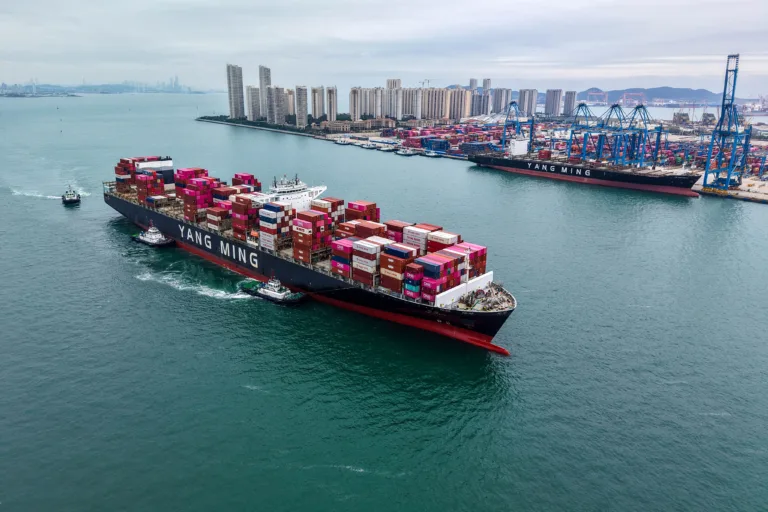
The third agreement suspends the implementation of Section 301 measures targeting China’s maritime, logistics, and shipbuilding industries, including tariffs on Chinese cargo vessels announced by Trump. “The U.S. suspended the punitive fees on Chinese ships docking at U.S. ports, right? And then China said: ‘OK, we will also wait with our measures’,” Li Bo details.