

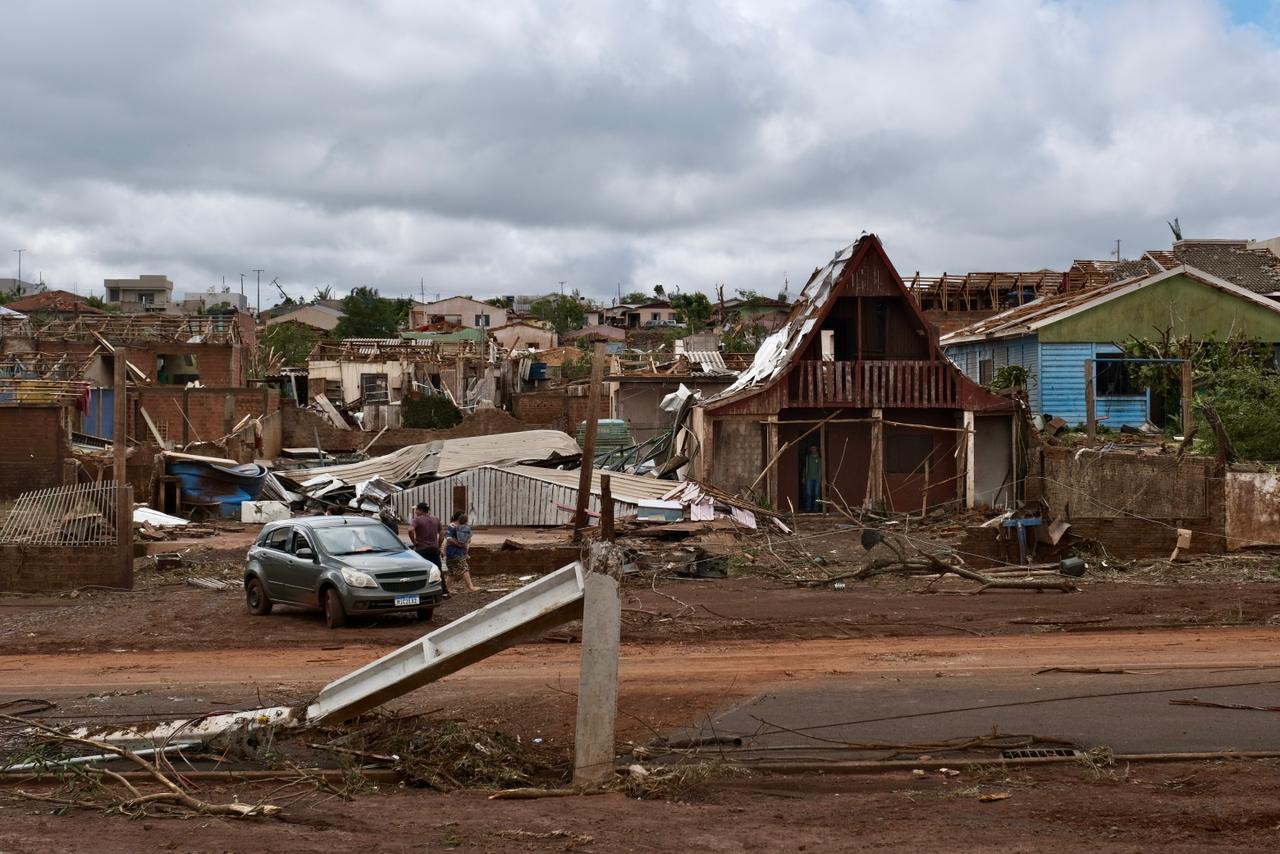
In southern Brazil, recovery efforts are underway after a powerful tornado tore through the state of Paraná on Friday (7), leaving seven people dead, 750 injured, and nearly 15,000 affected. The city of Rio Bonito do Iguaçu, home to 14,000 residents, was almost entirely destroyed, with 90% of its urban area damaged by winds reaching up to 250 km/h.
Authorities at the state and federal levels have declared a state of calamity to accelerate access to emergency funds and reconstruction. The federal government has deployed health, logistics, and civil defense teams to the region. According to Regional Development Minister Waldez Góes, it is still “impossible to measure all the damage,” but immediate action is being taken to restore essential services and support affected families. The federal administration estimates that rebuilding public infrastructure, including schools and housing, will require at least R$15 million (about US$2.7 million) in initial funds.
Emergency response and solidarity
The Ministry of Health has sent a special team from the National Health Force, including doctors, nurses, and mental health specialists. The National Institute of Social Security (INSS) is evaluating the early release of benefits to workers who lost their homes or jobs. The state government has also proposed allowing up to R$50,000 (about US$9,000) in assistance per family through the State Fund for Public Calamities (Fecap).
Across Rio Bonito do Iguaçu, emergency shelters were set up in schools and sports centers to provide food, clothing, and shelter. Volunteers and community groups have organized mutual aid kitchens and food drives to feed displaced families.
One of the most active responses has come from the Landless Workers’ Movement (MST), which quickly established solidarity kitchens and reconstruction brigades. “Everything was destroyed, things that families spent their whole lives building were lost in seconds,” said Bruna Zimpel, a national MST coordinator. “Solidarity always arrives before official aid.”
Rebuilding amid trauma
Residents describe scenes of total devastation. “The storm was so strong, there was darkness, noise, chaos. I hid under a table and thought I wouldn’t make it,” said Joelson Crecencio, a local farmer whose home was partially destroyed.
Power is slowly being restored: the Copel energy company reported that nearly half of the city’s grid is now functioning. But for most residents, the main task ahead is rebuilding. “We need to help families with health care, food, and housing,” said Minister Góes, adding that President Luiz Inácio Lula da Silva had instructed ministers to ensure “no demand goes unanswered.”
**With informations by Clivia Mesquita, Agência Brasil and Radio BdF.
