

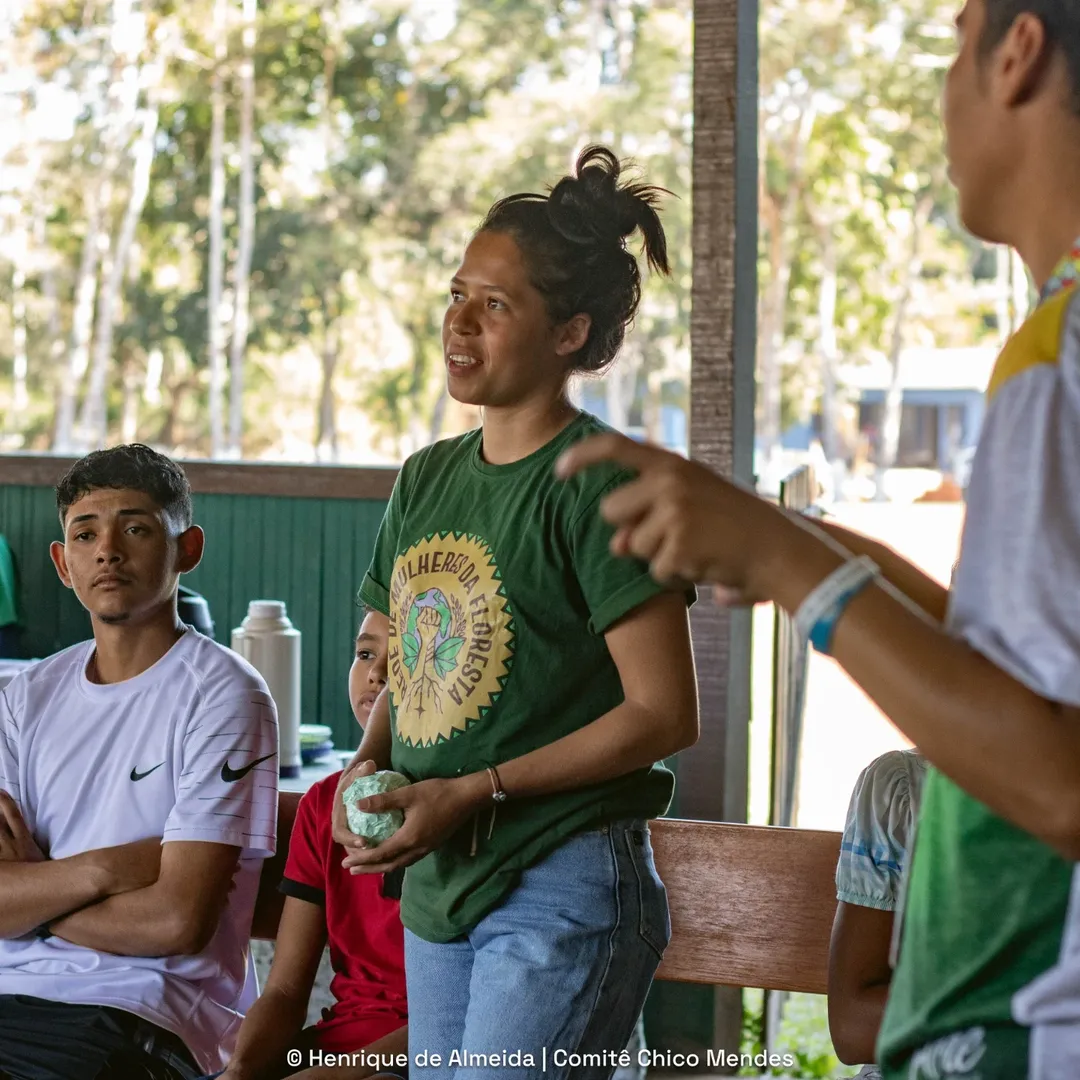
A year and a half from now, young Kailane da Silva Souza will complete her degree in business administration. But even before graduating, she already has a profession. “I’m a rubber-tapper,” she says.
A resident of the Chico Mendes Extractive Reserve in the Brazilian Amazon, leaving only for outings and events, Kailane is the president of the Varadouro Collective, which brings together young people to defend their ways of life.
The group’s goal is to improve working conditions in the forest so more young people choose to stay. “If we maintain the culture of our ancestors, we can preserve what they protected in the past,” says Richele Silva de Souza, an extractivist, pedagogy student, and member of the collective.
Between July and August 2025, these young people conducted an unprecedented survey based on interviews with residents of the Acre state’s extractive reserves. The document, titled Extractivist Peoples of the Amazon and Their Importance in COP30 Negotiations, offers recommendations for negotiators, decision-makers, and policymakers to recognize extractivist populations as central actors in the climate agenda.
The researchers spoke with 180 extractivists to gather data and insights about their daily lives and their perceptions of the climate crisis. “During this time, I was able to see how much people living in the reserve are being affected by the climate crisis. They’re being impacted in their food, their health, and their daily lives,” says Richele, who took part in the study by conducting several interviews with residents of the Chico Mendes Extractive Reserve.
“Animals have disappeared, fish have declined, water is becoming scarce, and even the vegetation is dying. All of this has severely harmed family farming and extractivism. Beans, rice, corn, crops that once had predictable planting seasons, no longer follow any pattern,” she laments.
The results of the study were presented during a side event at the 30th United Nations Climate Change Conference (COP30) in Belém, Pará, in a space organized by the Chico Mendes Committee. The document was also delivered to Brazil’s Minister of the Environment and Climate Change, Marina Silva.
The effort to document the daily lives of extractivist communities and to produce materials like the one presented at the conference in Belém has a clear purpose: to influence public policies in favor of these populations. After all, they are the ones protecting their territories while the climate crisis looms ever closer.
“All of this made me understand that the climate crisis isn’t something distant. It’s happening every day, directly affecting those who depend on extractivism and on nature to survive,” Richele warns.
‘There are very few young extractivists’
For young women like Kailane and Richele, one of the collective’s most important goals is finding ways to keep youth in the countryside.
Over the past 22 years, Brazil’s rural population has declined at a pace faster than the global average. World Bank data from 2024 show that the share of Brazilians living in rural areas fell by 33.8% between 2000 and 2022. Worldwide, the drop was 19.2%.
The trend disproportionately affects young people and is closely linked to the lack of work and educational opportunities in rural areas, according to statistics from the National Confederation of Agricultural Workers (Contag) and the Inter-Union Department of Statistics and Socioeconomic Studies (Dieese).
Among those who do stay in rural areas, few remain in extractivism, Kailane notes.
“It’s a fact that there are very few young extractivists today,” she says. Many young people switch sectors and turn to cattle ranching, which offers quicker financial returns. “What people want to expand in the reserves today are clearings and burning for cattle. And young people, especially, get drawn into this… The idea that cattle, ranching, brings faster income,” she explains.
Richele believes the lack of work and study prospects pushes young people out of these territories, and often, they don’t return. “Young people need to leave their communities to study, to look for work, because there’s nothing there. No resources, no jobs, no education,” she says.
Both women are currently pursuing university degrees online, the path they found to continue studying without abandoning life in the forest.
“For now, I don’t plan on leaving,” Kailane says. “I’ve lived there since I was born, I’m 20 years old,” she adds. She is also part of the Women of the Forest Network of the Chico Mendes Committee, which seeks to strengthen young extractivist women, and she coordinates the grassroots nucleus of the Dois Irmãos community, where she lives. All of these roles converge toward improving livelihoods for forest communities.
To achieve this goal, the youth of the Varadouro Collective, in partnership with rural unions, organizations, and social movements, take part in training activities and events where they exchange experiences and expand their knowledge.
In June, Kailane traveled to Bonn, Germany, for the preparatory conference for COP30. “It was a very rich experience, full of information, everything very new,” she says. She learns from these gatherings, but also has much to teach.
“The best time to make the cuts is in the morning, early dawn, or late afternoon, toward evening. During the day, we do other activities, go to the fields, do other work,” she explains about her daily routine in the rubber groves. The lessons on caring for the trees and preparing the soil were passed down by her parents, who are also extractivists.
To walk through the dense forest, rubber-tappers open narrow trails through the vegetation, called varadouros. The collective borrows its name from these paths, symbolizing the routes they aim to carve out toward a possible future, guided by the knowledge of the forest.
Today, about 30 young people from the five extractive reserves in the state of Acre participate in the Varadouro Collective: Chico Mendes, Riozinho da Liberdade, Alto Juruá, Alto Tarauacá, and Cazumbá-Iracema. The research presented by the youth at COP30 was conducted in these areas.
“Even with all the difficulties, what moved me the most was seeing that the people living in the Resex don’t want to give up. They want to keep fighting, resisting, believing in a better future,” Richele says.
Deforestation
Cattle ranching brings faster financial returns, but its environmental consequences come just as quickly. Although roughly 91% of its forests remain intact, the Chico Mendes Extractive Reserve is, among all protected areas, the most threatened by deforestation in the Amazon.
The data comes from periodic studies by the Institute of Man and Environment of the Amazon (Imazon), a Brazilian non-profit research organization whose mission is to promote conservation and sustainable development in the biome.
Deforestation inside the reserve has increased especially since 2018. Along its borders, pasturelands continue to expand. The clearing of trees near river springs destroys the water sources local residents depend on. “There’s no more water. People have to leave their settlements because it no longer exists,” Richele warns.
Extractive reserves are collective-use territories created to ensure that forests remain standing. Residents harvest Brazil nuts, açaí, latex, and other products, all activities carried out without cutting down trees.
“I believe extractivists preserve the forest every day, because they can only extract from the forest if it is standing and alive,” says Kailane. Most of the Chico Mendes Reserve lies within the municipality of Xapuri, where the rubber-tapper, environmentalist, and union leader Chico Mendes lived and was assassinated — the figure whose name was given to the reserve, which remains protected today despite ongoing threats.
