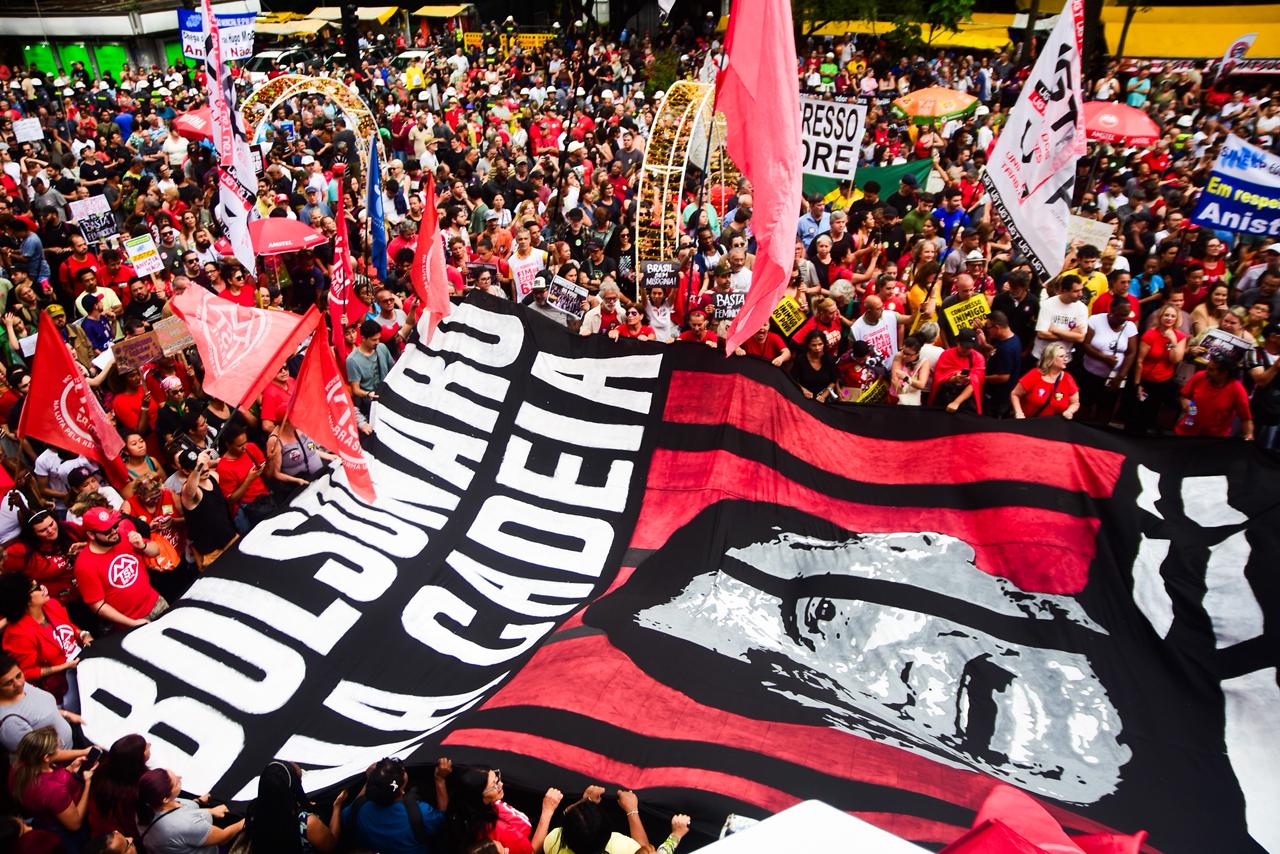
This Sunday (14) marked another day of nationwide street mobilization, as demonstrators demanded that Brazil’s Congress listen to popular demands. This time, protests targeted the so-called Dosimetry Bill, which significantly reduces sentences for those convicted of the attempted coup, including former president Jair Bolsonaro.
On São Paulo’s Paulista Avenue, politicians joined the demonstration, including left-wing lawmakers Erika Hilton and Ediane Maria, and artists such as Chico César, Romero Ferro, and Zélia Duncan. The mobilization came just one week after the Mulheres Vivas uprising, which brought thousands of people to the streets in dozens of cities to denounce gender-based violence and Brazil’s high femicide rates.
Singer Chico César performed during the protest and criticized the presidents of the Chamber of Deputies and the Senate. “People are taking to the streets to say Congress cannot do whatever it wants. The people are vigilant. Participatory democracy is exactly this: the power of the streets,” he said. Referring to Hugo Motta (House Speaker) and Davi Alcolumbre (Senate President), César said Brazil is “ashamed.”
Zélia Duncan said she believes in the strength of street mobilization and stressed the need to make better political choices in elections. “Every Brazilian needs to speak out, take to the streets, and next year vote wisely. Please think carefully before voting. Let’s stand together. Brazil belongs to the people. Let’s show these enemies of the people that the people are watching.”
Former federal lawmaker and former Workers’ Party (PT) president José Genoíno also attended the Paulista Avenue protest, highlighting the importance of public mobilization in confronting Congress’s conservative agenda. “Here we decide the defeat of the dosimetry bill. Here we defeat backroom deals. Here we confront an ongoing coup. This protest signals that organized people in the streets are entering the political arena as a new force,” he said.
Retired professor Tito Valencia described recent votes by federal lawmakers as “grim” and said only sustained street pressure can reverse measures such as the Dosimetry Bill. “We need to change this. What we have to do is take to the streets and make this movement grow until it has real impact.”
‘Congress: enemy of the people’
“Disguised amnesty” or “soft amnesty” were the most common labels used to describe the Dosimetry Bill during the protests. While the far right attempted to advance a bill granting full amnesty to those convicted of the coup attempt, what moved forward instead was a proposal that sharply reduces their sentences.
If approved by the Senate, the bill would allow Jair Bolsonaro to serve just over two years in prison before transitioning to house arrest, hence the nickname “disguised amnesty.” Bolsonaro was sentenced by Brazil’s Supreme Court (STF) to 27 years and three months in prison for his role in the coup plot.
President Luiz Inácio Lula da Silva said this week that he will only decide whether to sign or veto the Dosimetry Bill once it reaches the presidential palace. Before that, the proposal must still be debated and voted on in the Senate.
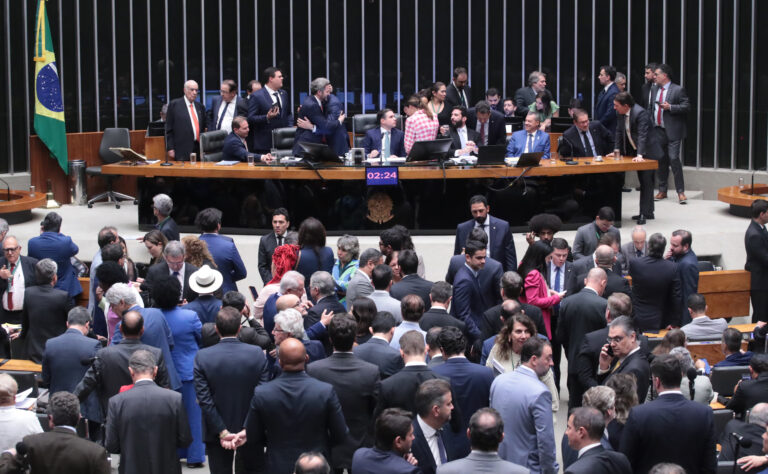
The Dosimetry Bill was approved in the early hours of Wednesday (10) amid scenes of violence and repression inside Congress. Lawmaker Glauber Braga was forcibly removed from the chamber after denouncing the bill and resisting a vote on the revocation of his own mandate.
“My presence at the speaker’s table was to show that we cannot give in,” Braga said at the time. “Tomorrow there will be a vote on my removal. They may strip my mandate, but until the last minute I will fight, not for myself, but to prevent them from attacking democratic freedoms. In the same package, they want to pass an amnesty disguised as dosimetry and preserve the rights of a lawmaker [Eduardo Bolsonaro] who is outside the country.”
During the session, the TV Câmara broadcast signal was cut, an unprecedented move since Brazil’s return to democracy. For popular movements, the episode reinforced the perception that Congress is acting increasingly detached from society.
Protests across Brazil and the Iberian Peninsula
Demonstrations were held in at least 14 state capitals. In Belém, the capital of Pará, the protest began in the morning at the Estação das Docas. In Belo Horizonte, demonstrators gathered early and marched to Praça Sete. In Brasília, the protest started at the Museum of the Republic and headed toward the National Congress.
In Porto Velho, the capital of Rondônia, the demonstration took place at the Madeira-Mamoré Railway Square, with a focus on opposition to the “Marco Temporal” framework affecting Indigenous land rights. In southern Brazil, Porto Alegre saw thousands march on a sunny afternoon from Redenção Park to the Açores Bridge.
Protests were also held abroad, including in Porto and Lisbon, Portugal, and in Barcelona, Spain, organized by a local chapter of Brazil’s Workers’ Party (PT).