

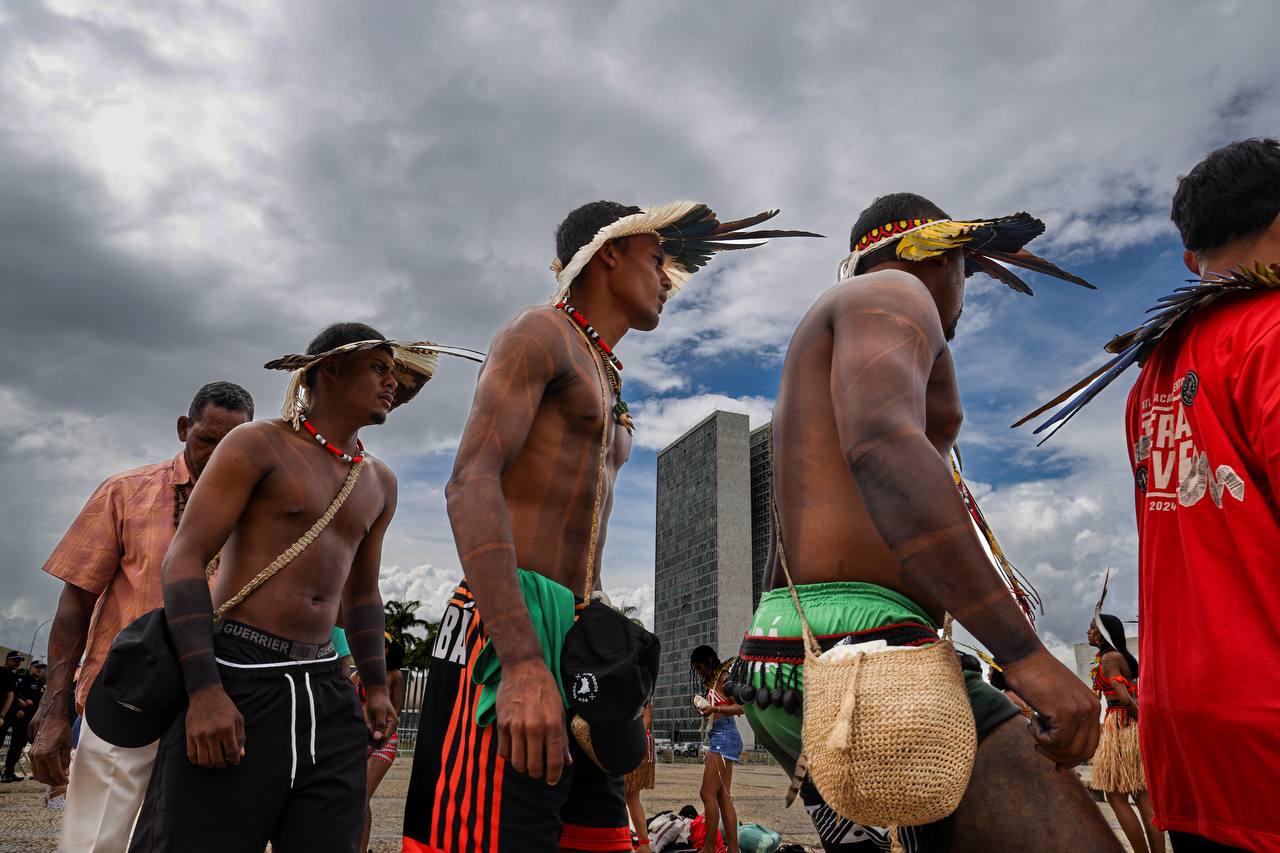
On Wednesday (17), Brazil’s Supreme Federal Court (STF) reached a majority to strike down the so-called timeframe thesis used in the demarcation of Indigenous Lands.
By six votes, the justices ruled the doctrine unconstitutional. The thesis establishes that Indigenous peoples in Brazil can only claim the demarcation of territories they occupied on October 5, 1988, the date the Federal Constitution was enacted. Under this rule, lands occupied prior to that date or reoccupied afterward could not be legally recognized as Indigenous territories.
The Court’s ruling, however, opened a loophole that facilitates access by non-Indigenous actors to these territories for economic activities such as mining and agribusiness.
“This is prohibited by the Constitution, because the usufruct of these lands is exclusive to Indigenous peoples,” warned Rafael Modesto, legal advisor to the Indigenous Missionary Council (Cimi), an organization that has worked for nearly 50 years to defend the rights of Indigenous peoples.
On this issue, Justice Flávio Dino was the only member of the Court to oppose allowing economic exploitation of Indigenous territories. Alongside Dino, Justices Alexandre de Moraes, Cristiano Zanin, Dias Toffoli, Luiz Fux, and Gilmar Mendes, the rapporteur of the cases, have already cast their votes. In his opinion, Mendes acknowledged the violence suffered by Indigenous peoples, but defended measures that favor land invaders.
The rapporteur’s vote
In a passage of his vote, Gilmar Mendes stated that “our society cannot live with wounds opened centuries ago that still await resolution today.”
Mendes warned that fixing October 5, 1988, as a historic cut-off point places Indigenous peoples in a “situation of difficult proof, given that Indigenous communities were historically dehumanized through state or private practices of forced removal, killings, and persecution.”
Despite this, the rapporteur supported a rule allowing illegal occupants to remain on Indigenous land until they receive compensation. Mendes’ vote also favors the carrying out of agribusiness activities on Indigenous Lands, provided they include community participation and do not result in land leasing.
Another unfavorable point for Indigenous peoples is the possibility of offering an equivalent territory in another location if demarcation proves difficult, as warned by Ricardo Terena, a lawyer with the Articulation of Indigenous Peoples of Brazil (Apib).
“We know that our territories have no equivalent land. It’s not just a piece of land, there is an entire traditional, ancestral relationship with that region,” he said.
Terena followed the vote from Brasília. Outside the STF building, he joined other Apib representatives, as well as Indigenous peoples and leaders from the Articulation of Indigenous Peoples and Organizations of the Northeast, Minas Gerais, and Espírito Santo (Apoinme), in a protest against PEC 48, a proposed constitutional amendment that seeks to establish the timeframe thesis in the Constitution.
One day before the STF ruling on Indigenous land rights, on Tuesday (9), Brazil’s Senate fast-tracked and approved the amendment.
The judgment, held in a virtual plenary session, examines the constitutionality of Law 14,701, which regulates the demarcation, use, and management of Indigenous lands in Brazil. The case will continue on Thursday (18), when Justices Edson Fachin, Cármen Lúcia, André Mendonça, and Nunes Marques are expected to vote. The Court is analyzing four lawsuits challenging the timeframe thesis law.
Ban on land reoccupations
In another contradictory aspect, Gilmar Mendes’ proposal bans so-called land reoccupations and allows for the forced removal of Indigenous occupants. “He says that if Indigenous peoples carry out reoccupations from now on, the police won’t need a court order to remove them [from the occupied area],” Modesto explained.
Reoccupations are organized actions in which Indigenous communities occupy land invaded by non-Indigenous actors, as a way of pressuring the state to regularize their territories. “Indigenous peoples use reoccupations as a tool of pressure, including to push the executive branch to speed up demarcation processes, so they don’t remain indefinitely on the margins of highways or in areas where they cannot reproduce themselves physically and culturally,” Modesto said.
In his vote, Mendes equates these actions with invasions of ancestral territories, invasions that historically displaced Indigenous peoples from their lands and cultures. “In other words, from any angle, invasions, reoccupations, and expulsions are unlawful acts and must be understood as such, in order to prevent barbarism and chaos from becoming permanently entrenched and dominant in rural areas,” the rapporteur’s text states.
According to the proposal, the plan establishes protocols for so-called “humanized evictions” and civil and criminal liability for anyone who disrupts rural peace. In practice, however, Indigenous peoples are routinely subjected to violence by gunmen and state agents, as has been the case for years in Mato Grosso do Sul, where the Guarani and Kaiowá, increasingly confined by cattle ranches and monoculture plantations, have organized reoccupations and face constant intimidation, threats, and killings.
In September this year, at least two Indigenous people were struck by rubber bullets during an operation by riot police in the municipality of Caarapó. About 140 kilometers away, a young Indigenous man was killed in an armed attack on the Pyelito Kue reoccupation area, in the municipality of Iguatemi, in November.
