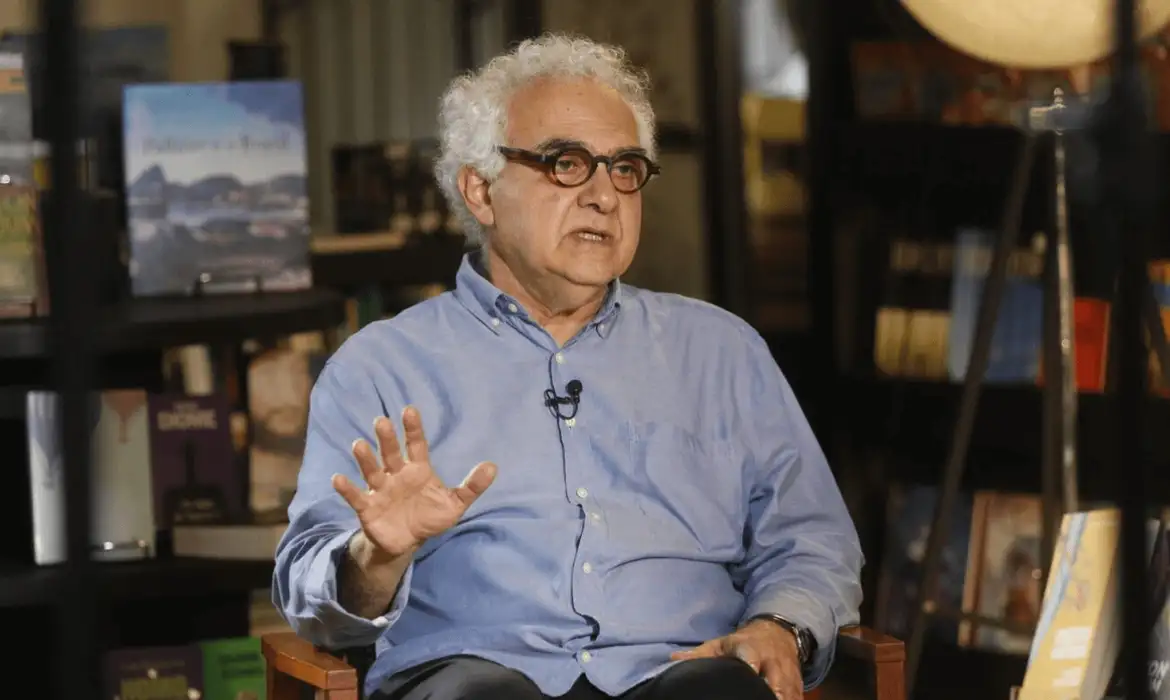
After two years of the genocide of the Palestinian population in the Gaza Strip, carried out by Israel with the support of the United States, and in the absence of meaningful responses from international institutions and major powers, “everything becomes possible,” says Brazilian writer Milton Hatoum. For Hatoum, a member of the Brazilian Academy of Letters (ABL), it is within this context that the recent U.S. imperial attack on Venezuela must be understood.
“The genocide continues. More than 500 Palestinians have been killed after the supposed ceasefire. Everything happened and no one did anything. As in Gaza, it happened in Venezuela. We know the real reasons that led the U.S. government to kidnap President Maduro. It’s all about oil, just as in the Middle East it’s oil, gas, geopolitics, and Israel’s expansion, a project anyone with some historical knowledge already understands,” he said in an interview with Radio BdF.
Hatoum has just released Dança dos Enganos (Dance of Deceptions), the third volume of his trilogy O Lugar Mais Sombrio (The Darkest Place), which addresses Brazil’s military dictatorship. He is also widely recognized for his contributions to environmental debates, particularly regarding the Brazilian Amazon.
A few months after the 30th Conference of the Parties (COP30) held in Belém, Hatoum stresses that protecting the Amazon cannot be separated from global geopolitical dynamics. He emphasizes the importance of Brazilians electing a leader committed to this agenda in this year’s presidential elections.
“When international law is disregarded, as it was in Gaza, everything becomes possible through the force of empire and weapons. We are living in an era of imperial fascism. What would stop an imperial power tomorrow from claiming that part of the Amazon belongs to it because of water or mineral resources? We must talk to young people about Brazil’s elections and about the threat it would pose if Lula were to lose,” he warned.
Read the full interview
BdF – How does it feel to finish writing a trilogy?
Milton Hatoum – When you finish a novel that took so long, you feel a bit emptied out, but at the same time you begin preparing for a new imaginary journey. I was already sketching another novel, actually. I even wrote a very preliminary version of this new book, which has some points of contact with the trilogy. But I will still have to rewrite and revise it. That will take some time.
The trilogy was a project from my youth that was postponed for more than three decades. I wanted to fictionally narrate, based on my experience during the dictatorship, the lives of the young people of my generation, or part of them, because not all young people of my generation fought against the dictatorship. On the contrary, many supported it or were indifferent to any political issue.
It took me a long time to architect this book, which was somewhat ambitious without being pretentious. When I finished Ashes of the North, which is something like a “cousin” of the trilogy, I began to think about this large fresco, this coming-of-age novel. I spoke with many friends, people from my generation, and revisited Brasília several times.
I hadn’t been to Brasília since I left in 1970 or 1971. I only returned 30 years later. There, I reconnected with some people, all already elderly like me, but who were strong and had very vivid memories. I also met again with friends from São Paulo who had lived with me at the University of São Paulo, in shared houses in Vila Madalena.
It was a process of excavating memory and revisiting those places in order to invent another story, with its contradictions, impasses, and dreams. The last volume has just been released, and it took a long time because with each volume I revised the previous one. I revised the first, published it. Before publishing the second, I rewrote many things again. And the third was the most laborious.
This also happened because of the epidemic and the previous government, which threw us off balance and represented a real threat to Brazilian democracy, which had been achieved at great cost. Many people gave their lives at that time fighting the dictatorship.
I also faced technical challenges, because this third volume is very different from the others. There is a shift in narrative perspective: there is a book written by a woman, the mother of the main character, and now she tells her story and listens to other stories, which she adds to her memories.
Recently, in an interview on Roda Viva, you said you did not expect authoritarianism to return to Brazil, drawing a parallel between the military dictatorship and the government of Jair Bolsonaro. In these first days of the year, we are talking about the United States’ attack on Venezuela. Did that also surprise you?
Regarding the election of the previous government, I truly did not expect it. I think very few people did. I am not a fortune teller. Machado de Assis plays with this in Esau and Jacob, when the mother of the twins Pedro and Paulo, one a monarchist and the other a republican, consults a fortune teller who says, “they will be great, great future things.” We do not have that power, and I really thought this would not happen.
Despite everything we saw during the United States government’s first term, we also did not have much conviction that this could happen. But I think now everything can happen. If we think carefully, after more than two years of a massacre, of a genocide in Gaza, in which no European, Asian, or Arab power intervened to stop it, everything becomes possible.
The genocide continues. More than 500 Palestinians have already been killed after the supposed ceasefire. They are invading properties in the West Bank, and I read that they want to destroy a soccer field, the only space of leisure and relief for children in a refugee camp in that hell. After that, everything happened and no one did anything.
As in Gaza, it happened in Venezuela. I am not defending the Maduro regime. We can assume there is an authoritarian government or that elections were fraudulent, but that does not allow one country to invade another and kidnap its president. That is obvious. We know the real reasons that led the U.S. government to kidnap President Maduro: everything is oil.
Just as in the Middle East it is oil, gas, geopolitics, and the expansion of Israel, a project that anyone with some historical knowledge already understands. There is a letter from a character named Nortista, from Manaus, at the end of the second volume of the trilogy. He writes to Martim, who is exiled in France. The letter is dated March 12, 1980. The general amnesty for both fighters and executioners of the dictatorship was in August 1979. Nortista writes:
“Many exiles and expatriates are already here. Strike movements continue, workers have been repressed, several leaders arrested, mass layoffs. This is the promised political opening of the general president, a crude and vulgar farce. The military and civilian coup plotters are weakened. One day they will fall away, and then the nostalgics of infamy will strike again with the complicity of the powerful brother from the North. Every 20 or 30 years, Moloch changes its mask but keeps the same head of greed and cruelty and the same womb that devours children. There will be new times of wandering, nightmares in full wakefulness, dishonor of body and mind. Even so, there is hope, bitterness, and euphoria, all mixed together. The eternal Brazilian dithyramb: violence, suffering, laughter, promises, and posturing.”
He writes in 1980, predicting that every 20 or 30 years this cycle of the empire from the North returns, sometimes with greater force. Something similar appears in Dança dos Enganos in the voice of a Salvadoran woman, Justina Anaya. Her companion wants her to go to Brazil, but she refuses because she does not want to be clandestine again under a dictatorship. He says the dictatorship is agonizing, and she replies: “Yes, but these monsters do not die; they are reborn and return with force.”
As in ‘The Secret Agent,’ a film competing for the Oscar and awarded at the Golden Globes, whose protagonist Marcelo is not a militant but suffers the violence of the dictatorship, in Dança dos Enganos the protagonist Lina is also not a militant. Did you make that comparison?
Yes, I thought about that situation. I myself did not belong to any party or clandestine organization. I was never a party militant. But it was enough to be on the streets, in a demonstration, or distributing a leaflet.
Many people who were not directly involved in fighting the dictatorship were arrested, and some even died. They pursued those directly involved more aggressively, but many people who were simply protesting were also victims.
You also bring many discussions about the Amazon. How did you evaluate COP30?
I think the presence of thousands of Indigenous people in Belém was fundamental and unprecedented. I do not know what the concrete consequences of this COP will be, but what matters is that many young people are involved in the fight against climate change. Holding a COP in the Amazon was symbolically extremely important. We need to bet on planetary consciousness and the engagement of young people, because it is their very survival in 30 or 50 years that is at stake.
I do not know what the practical outcome of the decisions will be, especially since the United States officially refused to participate and is the world’s largest polluter. But governments change. There will be elections this year in the United States, and Congress will be renewed. If the current government does not have a majority in the House and the Senate, it will be difficult to implement disastrous policies.
However, we live in a strange world where Venezuela was invaded without congressional approval. Everything is possible through the force of empire and weapons when international law is disregarded, as it was in Gaza.
We are living in an era of imperial fascism, extremely dangerous. What would prevent an imperial power tomorrow from deciding that part of the Amazon belongs to it because of water or minerals? The Brazilian army does not have the strength to prevent it. China and Russia do, but Brazil and Europe do not. We even see Greenland being threatened with annexation.
Our action is limited, “ant-like,” but we must talk to young people about Brazil’s elections, explaining in a didactic way and without arrogance the threat that it would be if Lula were to lose these elections. It would be an irreversible disaster for the people and for the Amazon, which already faced an explicit project of destruction. We can only lend our voice, low-volume and limited, to people who are misinformed.