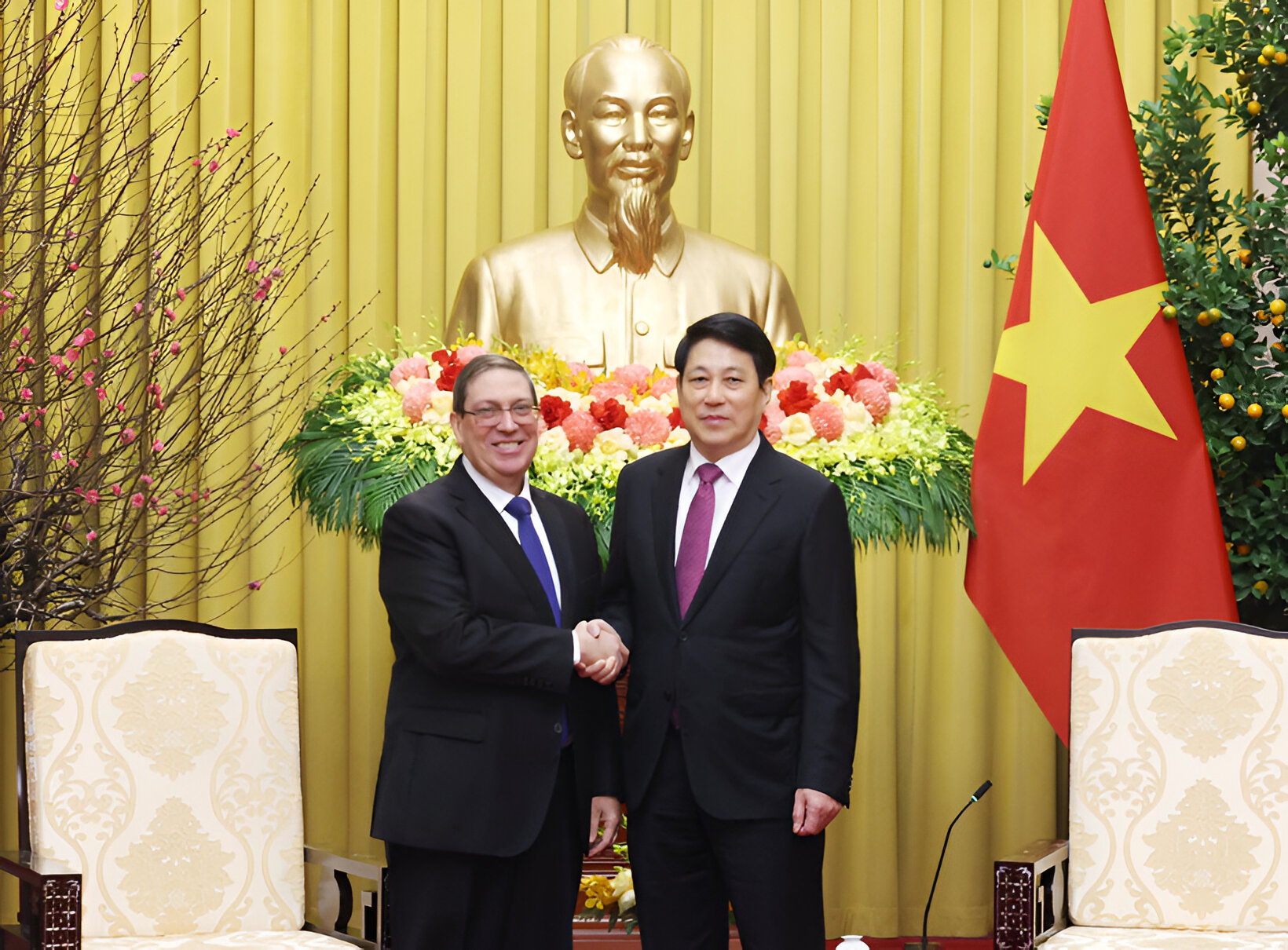
Amid escalating pressure from Washington, Cuba’s Foreign Minister Bruno Rodríguez Parrilla met on Tuesday (3) with Vietnamese President Luong Cuong in Hanoi, during an official visit aimed at strengthening strategic cooperation between the two socialist countries.
Rodríguez traveled to Vietnam as a special envoy of the Cuban government and the Communist Party of Cuba. During his stay, he held a series of meetings with top Vietnamese political leaders to expand bilateral cooperation in key sectors, at a time when Cuba faces renewed U.S. economic coercion.
According to a statement released by the Vietnamese government after the closed-door meeting, President Cuong reaffirmed that Vietnam “will never forget Cuba’s support during past hardships” and pledged continued solidarity with the island as it confronts current challenges. He also emphasized Vietnam’s willingness to deepen comprehensive cooperation through experience-sharing and the promotion of joint development projects.
The meeting took place shortly after the conclusion of the 14th National Congress of the Communist Party of Vietnam, which outlined the country’s development strategy through 2030, with a long-term vision extending to 2045. Rodríguez also met with Communist Party General Secretary To Lam, Prime Minister Pham Minh Chinh and Vietnamese Foreign Minister Le Hoai Trung.
Strategic partnership
Vietnam is currently one of Cuba’s main economic partners and the second-largest foreign investor in the Mariel Special Development Zone, a key hub for foreign investment on the island. The two countries maintain multiple strategic cooperation projects in agriculture, pharmaceuticals and energy, supported by bilateral agreements.
Since 2003, a Vietnam-Cuba cooperation project has been operating in rice production through Vietnamese enterprises working on Cuban land under usufruct agreements. Initially launched as a pilot initiative, the project is expected to expand to other areas of food production, including corn, soybeans, livestock and fisheries.
In early December, both governments announced plans to boost bilateral trade from its current level of around US$200 million per year to approximately US$500 million “in the shortest possible time.”
Asked on Monday (2) about recent U.S. measures threatening additional tariffs on countries that supply oil to Cuba, Vietnamese Foreign Ministry spokesperson Pham Thu Hang expressed concern about the potential impact of such actions on the Cuban economy and the well-being of its population. The measures are part of broader unilateral sanctions imposed by the United States, widely criticized by Havana and its allies.
Vietnamese media reported that recent talks in Hanoi focused heavily on expanding economic cooperation, particularly in the agri-food sector. Discussions included increasing Vietnamese companies’ participation in food production in Cuba, as well as transferring agricultural technology, machinery, inputs and technical expertise to help advance food self-sufficiency on the island.
Renewable energy development was also identified as a priority area, seen as essential to improving production capacity and living conditions in Cuba. Prime Minister Pham Minh Chinh expressed Vietnam’s readiness to share its experience in this field and proposed strengthening cooperation in biotechnology, including technology transfer and joint production of vaccines, biological products and specialized medicines for domestic use and export.
After the meetings, Rodríguez described the talks on social media as a “fruitful exchange,” noting that discussions covered both bilateral relations and the international situation, with particular attention to Latin America and the Caribbean.