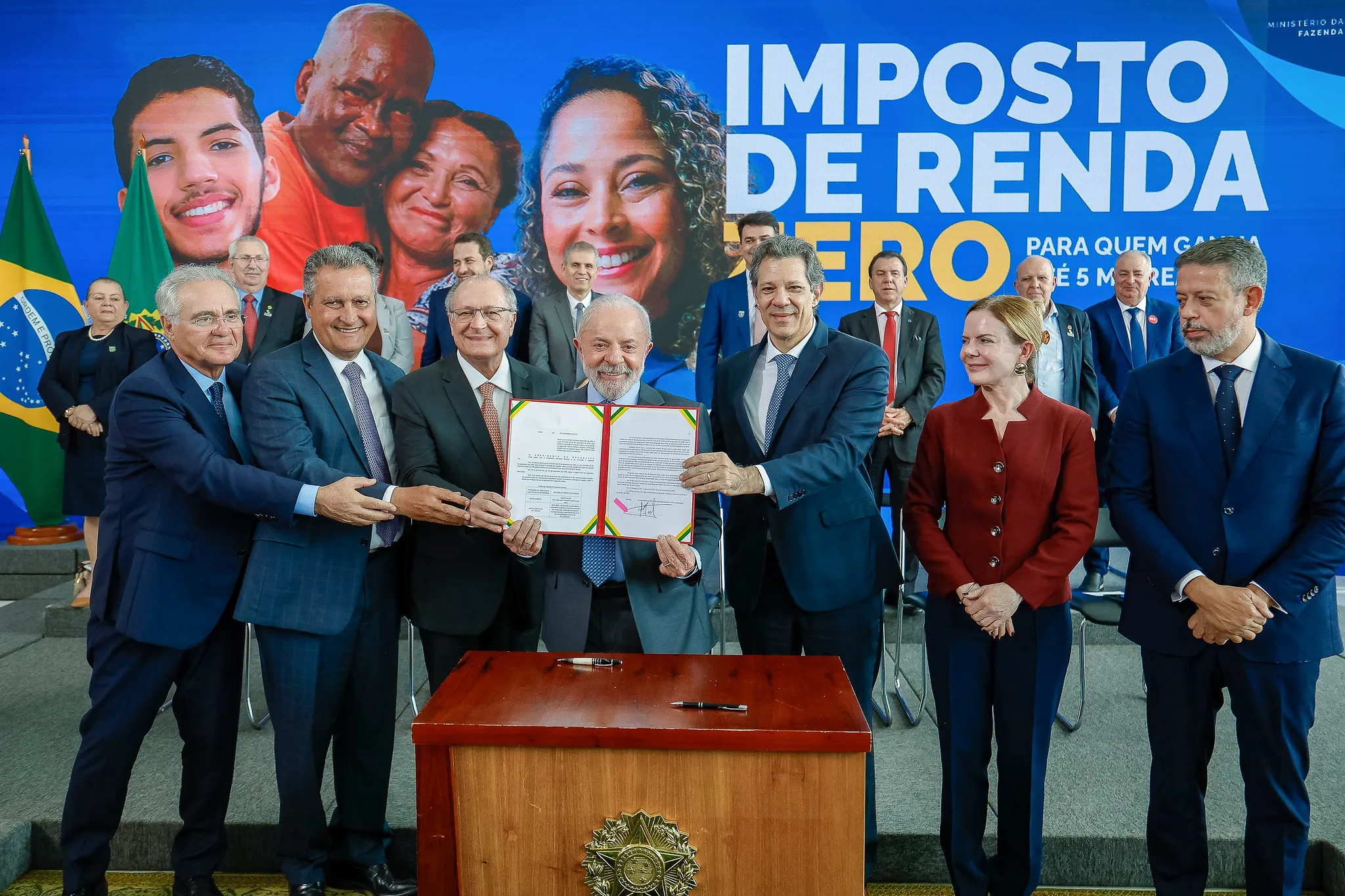
In an event attended by political leaders and union representatives, President Luiz Inácio Lula da Silva signed into law the bill that expands the income tax exemption bracket, fulfilling one of his main campaign promises.
The new law guarantees tax exemption for those earning up to R$ 5,000 per month (around US$ 1,000, a threshold that includes a significant portion of Brazil’s urban working class) and provides a progressive reduction for those with monthly incomes of up to R$ 7,350 (about US$ 1,470, reaching parts of the lower-middle class). The measure will take effect starting next year.
“You have no idea what today means. I will never forget the day you came to the Alvorada Palace and handed me this project in a folder. Here it is, your campaign promise. We are delivering it. And we are delivering it today,” Lula said, addressing Finance Minister Fernando Haddad.
The president argued that the new income tax rules represent a “tax revolution” in the country, helping to reduce persistent inequality.
“This country cannot continue to be as unequal as it is. It cannot, it doesn’t need to, and it shouldn’t. Because we have all the conditions to make a leap in quality. All the conditions. We just need to want it. I want it. I’m sure you want it. What we need is initiative,” he said.
Haddad, in turn, thanked the presidents of the Chamber of Deputies, Hugo Motta, and the Senate, Davi Alcolumbre, for their efforts in advancing the bill, which was drafted by the Executive Branch. “Without their diligence, it would have been impossible to celebrate this year and implement zero income tax starting next January,” said the minister, while criticizing previous administrations.
“The minimum wage went without adjustment above inflation for seven years. The income tax table went without correction for seven years. This caused 20 million Brazilians to start paying income tax simply because the tax brackets were frozen,” he pointed out.
Institutional Relations Minister Gleisi Hoffmann recalled that the project was one of Lula’s campaign promises in the 2022 election and considered it one of the most important measures of the current administration.
“I consider this one of the most important actions of President Lula’s term because it begins the process of addressing the deep wound of historical inequality in Brazil. The richest must pay more so that the vast majority of Brazilian workers pay less or pay nothing,” she said.
“We are taking an important first step to correct the enormous tax injustice in our country, which perpetuates the immense and repugnant income gap in Brazil,” the minister added.
‘Very close friends’
Hugo Motta and Davi Alcolumbre were absent from the ceremony but were represented by the rapporteurs of the bill in the Chamber and the Senate, Arthur Lira and Renan Calheiros, respectively. The two are political rivals in the state of Alagoas and exchanged barbs during the bill’s passage through Congress.
At Wednesday’s event, Lira said it was a “historic day for Brazil” and highlighted the unanimous vote in favor of the proposal in the Chamber of Deputies.
“It is not easy to achieve this, despite all the demands and needs this project addressed. There was unanimous guidance in the plenary. President Lula, in a digital vote, 493 deputies voted yes to the income tax exemption bill, with none voting against,” the congressman declared.
“This unanimity is not a mere detail. It shows, President Lula, the scale of this victory for your government and for Brazil, for the Brazilian people,” Lira added.
Calheiros highlighted his role in other historic projects during Lula’s first administrations, such as the creation of Bolsa Família (Brazil’s flagship conditional cash transfer program, internationally recognized for reducing poverty), the real increase in the minimum wage and the law guaranteeing labor rights to domestic workers. He also criticized the country’s “reactionary” elite.
“The elite has always reacted by spreading apocalyptic prophecies about devastating effects on the economy. Pure terrorism by the privileged, who always bet on panic in order to avoid change. President Lula, once again I feel honored to have contributed to a new revolution,” declared the senator, who defended higher taxation of sports betting companies and digital financial institutions known as fintechs.
“I sincerely hope, President, that this hard-earned money of workers and the poor does not go to gambling. Gambling, gambling that hides behind powerful sponsors, must and will pay taxes,” he said.
“I am coming, together with Senator Eduardo Braga, from a meeting of the Economic Affairs Committee, when we approved or at least began the review of a project that will irreversibly increase taxation rates on betting companies and fintechs in Brazil, also taking a significant step toward tax justice,” Calheiros announced.
Low representation
Attendance at the event was reduced compared to other major government ceremonies and to the magnitude of the project itself. Few social organizations were present.
Sérgio Nobre, president of the Unified Workers’ Central (CUT), Brazil’s largest national labor union federation, was the only civil society representative to speak. He emphasized the direct impact on Brazilian households and stated that the achievement “will mean an extra month’s salary per year for millions of Brazilian workers.”
“At the beginning of February, the working class will receive their first payslip without the income tax deduction, and it will be a celebration in the factories, President. And we, in the trade union movement, decided to make February a full month of celebration at factory gates, workplaces and communities, and to value this victory, which is a very great victory for the working class,” he said.
“On behalf of the entire working class, I want to thank President Lula for this historic achievement. Tax justice has been on the agenda of the labor movement for decades, and the income tax exemption for those earning up to R$ 5,000 is a giant step in that direction,” he stressed.
On the other hand, the union leader complained that profit-sharing payments (PLR) were not included in the tax exemptions and demanded progress on other fundamental issues for workers.
“Our strategic agenda, which now opens the way, is the reduction of the workweek to 40 hours and the end of the 6×1 shift system (a work regime in which employees work six consecutive days and have only one day off, still common in retail and services in Brazil). And also, finally, social and labor protection for colleagues who work through apps,” said Nobre. He added that workers will mobilize on December 9 in front of Central Bank offices across the country to demand a reduction in the basic interest rate. On that day, the next meeting of the Central Bank’s Monetary Policy Committee (Copom) is scheduled.