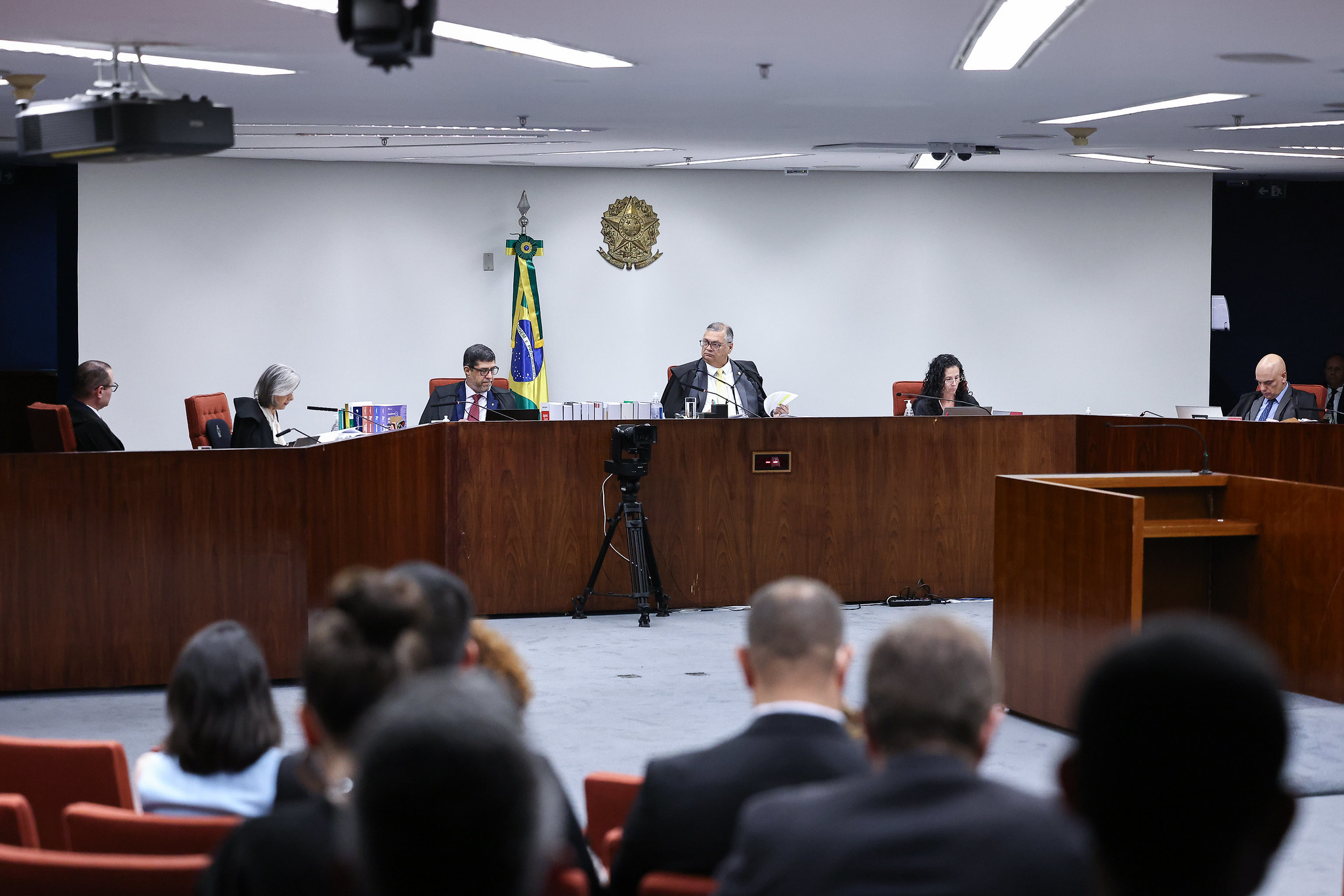
The First Panel of Brazil’s Supreme Federal Court (STF) will begin hearing Criminal Action 2693 next Tuesday (9), focused on what prosecutors call “Core 2” of the January 8th coup attempt, the group allegedly responsible for drafting the so-called “coup blueprint” aimed at overturning the 2022 election.
Six defendants, former senior officials in the Bolsonaro administration, police and military, are accused by the Attorney General’s Office of planning the document, monitoring authorities, and even proposing their “violent neutralization.” They are also charged with orchestrating efforts inside the Federal Highway Police to block voters in Brazil’s Northeast during the 2022 presidential election, a region where President Lula won by a wide margin.
The charges include attempted violent abolition of the democratic rule of law, coup d’état, participation in an armed criminal organization and destruction of protected public property. Among the accused are Silvinei Vasques, former head of the Federal Highway Police, and senior military advisors who served inside the presidency.
Defendants in Core 2:
- Fernando de Sousa Oliveira (Federal Police investigator)
- Filipe Martins (former presidential foreign affairs aide)
- Marcelo Costa Câmara (Army reserve colonel, former presidential adviser)
- Marília Ferreira de Alencar (former intelligence chief of the Federal Police)
- Mário Fernandes (Army reserve general)
- Silvinei Vasques (former Federal Highway Police director)
Hearings are scheduled for Dec. 9, 10, 16 and 17.
Supreme Court to revisit Indigenous land rights fight
On Wednesday (10), the full court will resume deliberations on whether a new federal law implementing the “Time Frame thesis” is constitutional. The law restricts Indigenous land rights to territories occupied on October 5, 1988, the day Brazil’s Constitution was enacted.
The STF has already ruled the thesis unconstitutional in 2023. A conciliation effort between government and agribusiness stakeholders, boycotted by Indigenous peoples, failed, and the court must now decide the law’s fate.
Final votes pending on pesticide tax exemptions
Also this week, the Court is set to finalize a major ruling on whether billions in tax breaks granted to the pesticide industry violate constitutional rights to public health and environmental protection.
Minister Edson Fachin voted to strike down the exemptions, Minister Cármen Lúcia agreed. Ministers André Mendonça and Flávio Dino argued for partial validity, while ministers Cristiano Zanin, Luiz Fux and Dias Toffoli voted to uphold the exemptions.
Justices Nunes Marques and Gilmar Mendes have yet to vote, meaning the ruling remains undecided. Brazil is currently the world’s largest consumer of pesticides, many banned in the Global North.
Racial justice ruling still pending
The Court must also conclude its ruling on whether Brazil must adopt a national plan to combat systemic racism (ADPF 973). A majority already recognizes that racism in Brazil is structural and institutional, but the justices are divided over formally declaring an “unconstitutional state of affairs”.
Some ministers argue that such a declaration is needed to force concrete state action on reparations. Others claim efforts are already underway and disagree with the formal classification.