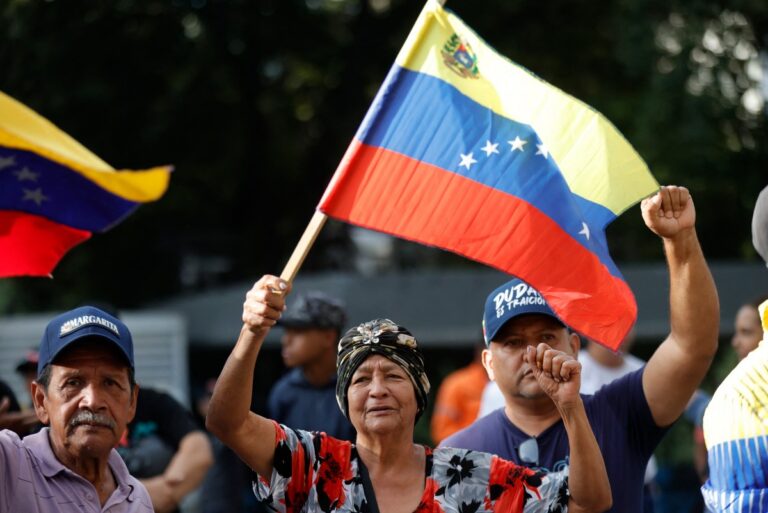
A wave of indignation swept major Brazilian capitals this Monday (5) following the attack on Venezuela and the kidnapping of President Nicolás Maduro by the United States last Saturday (3). Acts of solidarity and protests against the Trump administration were called in major Brazilian cities such as São Paulo, Rio de Janeiro, Salvador, Porto Alegre, Florianópolis, Brasília, Belo Horizonte, São Luís, and Aracaju.
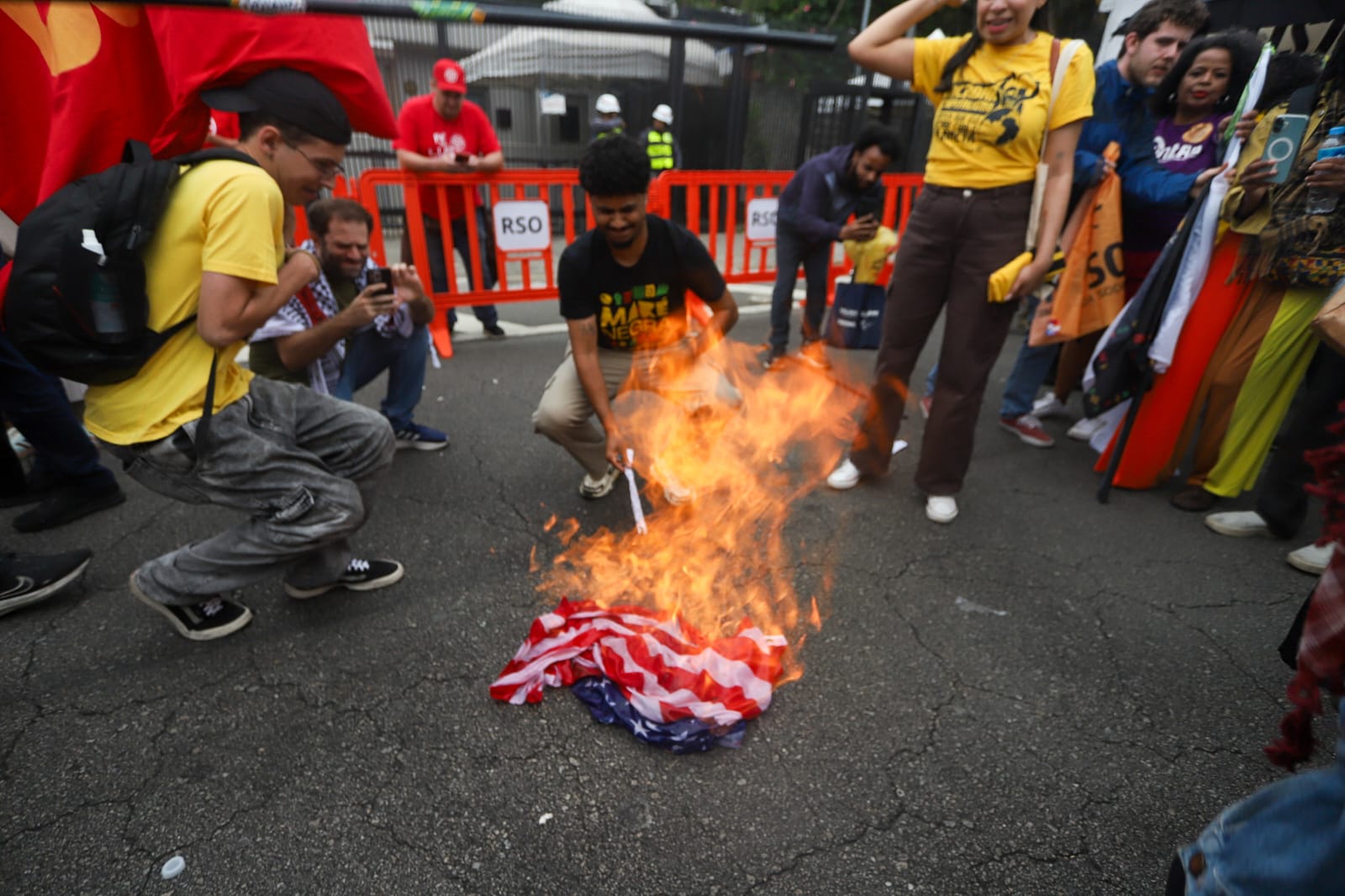
In São Paulo, popular movements staged a protest outside the U.S. Consulate in the city’s southern zone against the U.S. military attack on Venezuelan territory, which reportedly left more than 40 people dead, and against the kidnapping of President Nicolás Maduro and First Lady Cilia Flores by forces under Donald Trump’s command. Following the capture of the head of state, Venezuela’s vice-president Delcy Rodríguez assumed the role of interim president of Venezuela.
The protest in São Paulo, convened by the Landless Workers’ Movement (MST), was marked by the burning of the U.S. flag and chants calling for an end to foreign interventions in the region.

Demonstrators chanted in unison slogans such as “watch out, watch out, imperialist, Latin America will be entirely socialist” and “Israel out of Palestinian lands, Yankees out of Latin America.”
MST to go to Venezuela
During the mobilization, Gilmar Mauro, from the MST’s national coordination, emphasized the gravity of the moment and said the MST will send around 100 activists to Venezuela as a sign of support for the Venezuelan people. “We are here in defense of the sovereignty of the Venezuelan people and, obviously, condemning the brutal military kidnapping of a constitutionally elected president of Venezuela. We will send 100 MST militants to Venezuela.”
The movement’s representative said the MST is demanding Maduro’s release and that international law, “which is being torn up,” be respected.
Mauro said the U.S. president sent a message against Cuba, against Venezuela, and, by extension, against the Latin American people. “He wants to turn the Latin American continent into the United States’ backyard and steal natural resources, as he explicitly said about Venezuela’s oil. This sums up an assault on the sovereignty and dignity of our people.”

For Mauro, the response from popular mobilizations and political positions taken by governments must be very forceful; otherwise, the world could enter a period of enormous wars, not only on the continent, but globally. “Our relationship with Venezuela goes back more than 20 years. We have been there for just over 20 years. The country used to import 90% of the food it consumed and exported only oil. Today, the situation has reversed. Venezuela now produces nearly 90% of what it consumes, and we are there exchanging experiences with the peasant movement, contributing and partnering to produce grains, dairy farming, and seeds. We are proud of this relationship.”
The unity of left-wing forces was a central point of the demonstration. Luís Caseiro, from the Tecendo a Democracia collective, reinforced this stance. “We need to contain this imperialist wave that threatens all of Latin America, including Brazil. Our goal today is to show our opposition. If there is one thing politicians generally fear or respect, it is the people. The people must always organize, always mobilize, and unite, because without unity, they lose their strength.”

He added that unity on the left, with the broadest possible forces, is always necessary. “If we take a quick look around, we see representatives of the church, representatives from rural areas, people from São Paulo’s outskirts, students, combative youth, and university professors.”
Energy at the center
Energy issues were cited by protesters as the central driver of the U.S. offensive.
Pedro Augusto, a director at the Unified Federation of Oil Workers (FUP), stressed that strategic interest in oil motivates regional destabilization and warned that “the expansion of U.S. dominance over our region threatens not only our sovereignty, but our very existence as a people.”
According to him, protecting these assets is essential for the future, as they can ensure “the independence and the economy of our country and also enable a just energy transition.”
He emphasized the importance of ensuring that mineral and energy wealth meets popular needs amid the climate crisis.
Speaking outside the consulate, São Paulo city councilor Silvia Ferraro reinforced denunciations of Donald Trump’s ambitions, calling him an “oil thief” targeting not only Venezuela but also “Brazil’s rare earths and Latin America’s natural wealth.”
She recalled recent statements by the Republican leader to warn of risks to regional sovereignty, saying that “Trump wants to turn all of us into a U.S. colony, and we must reject and repudiate all of this.”

Ferraro also stressed the urgency of a coordinated response, arguing that it is necessary to take a firm stand against the U.S. attack. “Leaders of countries, left-wing leaders like Lula, like Claudia, like Petro, must be at the forefront of Latin American resistance against imperialism.”
One of the participants, Maria Fernanda Marcelino, from the executive coordination of the Women’s World March, spoke with Rádio BdF shortly after the rally. At the interview, she highlighted the speed of the collective response.
“Even though the attack happened in the first days of the year, the movements’ response was very timely and assertive in repudiating this attack, the coup attempt the United States has been trying for a long time. Organizations came together with strong unity, in defense of Venezuela and the Bolivarian revolution,” she said.
Marcelino emphasized that, beyond defending Maduro or his government, it is crucial to take a stand at a moment when all Latin American countries are threatened by Donald Trump’s imperial drive.
“The United States has no shame in saying it wants to administer Venezuela and that its main interest is oil. And we know Brazil has water sources, minerals, biodiversity, technology, just as other Latin American countries have human wealth that the United States wants to appropriate and turn our Latin America into its territory, its backyard,” she said.