

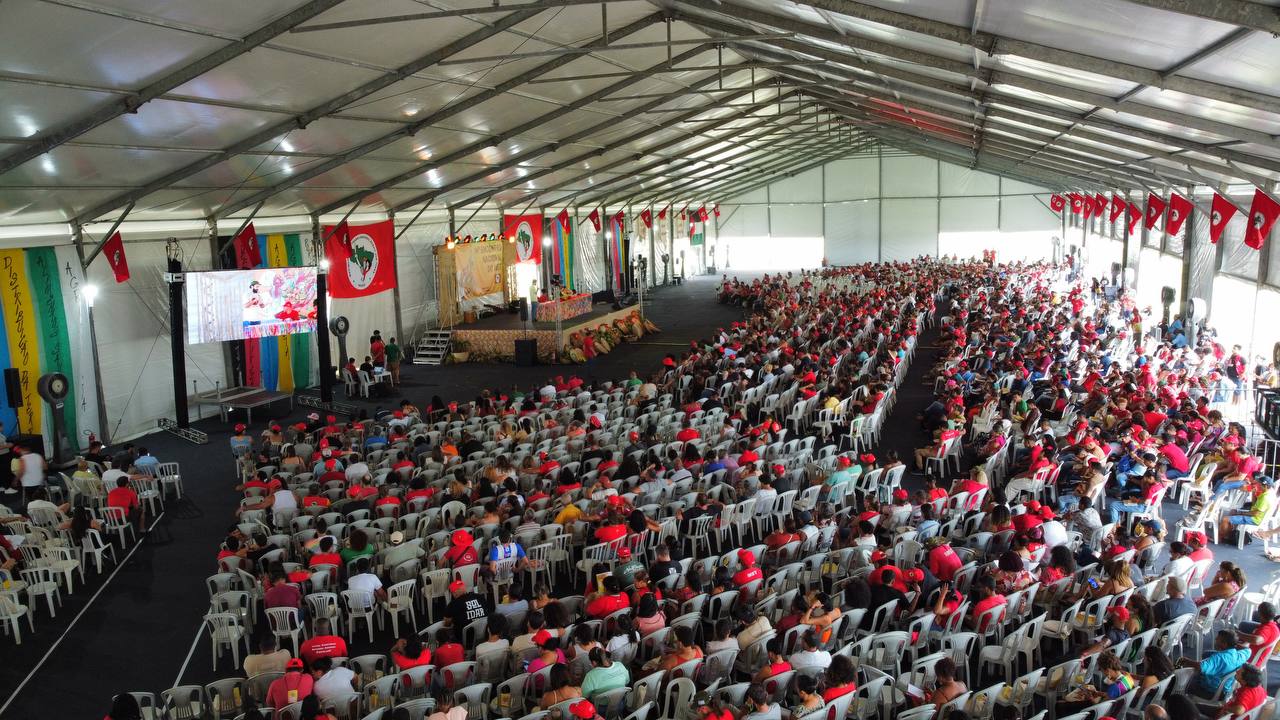
The National Meeting of Brazil’s Landless Workers’ Movement (MST) began this Monday (18) in Salvador, Bahia, bringing together around 3,000 militants from across the country in the state capital through Friday (23). The event’s goal is to assess and refine the movement’s political guidelines; review and implement the Popular Agrarian Reform program defined at the MST’s last congress in 2014, in Brasília; evaluate the organizational structure and strategic challenges; and debate key elements of the current political context, defining the organization’s course for the coming period, including its role during this year’s elections. As explained by Síntia Paula Carvalho, a member of the MST’s national leadership.
“It is a meeting focused on planning and study, on understanding capital, the assault of capital on nature’s wealth, socialism itself, and the struggle for land. We are here with more than 3,000 delegates from different states, from settlements and encampments, as well as partners who have contributed to the Landless Movement over the years,” the leader said.
For Ceres Hadich, a member of the MST’s National Coordination, the gathering is symbolic: the movement itself was founded in 1984 through a national meeting, and this is a moment for the organization to look inward.
“The MST is going through a process of organizational restructuring, seeing the challenges we face in this period and in the next historical phase of our struggle to advance the construction of Popular Agrarian Reform,” she said.
“We are in Salvador, Bahia, a land of struggle and resistance, the beginning, the middle, and the beginning of Brazil all over again. From Brazil’s Northeast, we want to read reality clearly and point out the challenges ahead in building Popular Agrarian Reform and advancing working-class struggles in our country,” Hadich added in an interview with Radio BdF.
In addition to MST militants from the 24 states where the movement is active, the meeting also includes a delegation of 100 international delegates. Santiago Vidal, from Uruguay and a militant of the Popular Participation Movement, traveled to Salvador specifically to attend the five-day gathering.
“Exchange is fundamental at a moment like this for the region. We naturally have a historic bond with the Landless Movement. Seeing more than 3,000 people gathered here to talk about the international situation, national reality, and agrarian reform is essential, an horizon that for us in Uruguay may seem distant today, but has been and remains a historic demand,” said Vidal, who was moved by the opening ceremony’s symbolism, held in solidarity with the Venezuelan and Palestinian peoples.
“When the mística is performed, a practice very characteristic of Brazil, it moves us deeply; our skin tingles and we are nearly in tears. It is a historic brotherhood. We are neighboring countries with shared struggles, demanding national sovereignty and anti-imperialism, issues central to our region and to Patria Grande,” he commented.
Manuel Bertoldi came from Argentina, currently governed by the far right. A militant of the Patria Grande movement and Alba Movements, he considers the MST a reference point for popular militancy in his country.
“For us in Argentina, it is very important to share these global reflections, because we are suffering the consequences of a neo-fascist government that is dismantling workers’ rights and pushing privatization of all our natural resources. Popular movements in Argentina have a fundamental task: to build unity, raise popular mobilization, and defeat the government we have today,” Bertoldi told BdF.
The first debate focused on the international political situation, especially in light of U.S. military aggression against Venezuela and Washington’s new national security doctrine, which poses a threat to the sovereignty of peoples in Latin America and worldwide.
Stefanie Weatherbee, a member of the International Peoples’ Assembly (IPA), argues that popular movements play a crucial role in the face of imperial military offensives against Latin American countries.
“A movement like the MST has the role of calling people to struggle and raising awareness at the grassroots about what is happening now on our continent, an attempt by the United States to reclaim control. The U.S. wants to retake our countries as colonies to exploit our resources even more than it already does. Every popular organization has the task of mobilizing struggles, educating its militants, and explaining what is happening,” she said, while rejecting pessimism about the future in light of the strength of popular movements.
“What we are experiencing is a reality shock. Imperialism has always been brutal and willing to do whatever it can to impose its agenda. In this more desperate phase, it acts in ways that may surprise us. I believe this shock can mobilize us even more. The challenge is not only to mobilize, but to organize, to create mechanisms to stay mobilized, sustain debate, and continuously analyze what is happening,” she added.
Although internal debates are restricted to delegates, part of the meeting is open to the public in Salvador, featuring the traditional Agrarian Reform Fair, Culinária da Terra, and Caminhos da Agroecologia, where participants can exchange seeds and seedlings and learn more about agroecological production practices.
This is also where the booth of the Permanent Campaign Against Pesticides and for Life is located.
“This is a fundamental moment to debate with the entire militancy the centrality of the struggle against pesticides and for the construction of agroecology. This is a civilizational debate. Brazil is the world’s largest consumer of pesticides, and each year we break another record. It is imperative that this debate be taken on with commitment and responsibility within the agrarian reform agenda,” said Jakeline Pivato, a coordinator of the campaign.
The program also includes cultural nights and a political rally in solidarity with Venezuela, scheduled for Friday (23), which will close the meeting.
