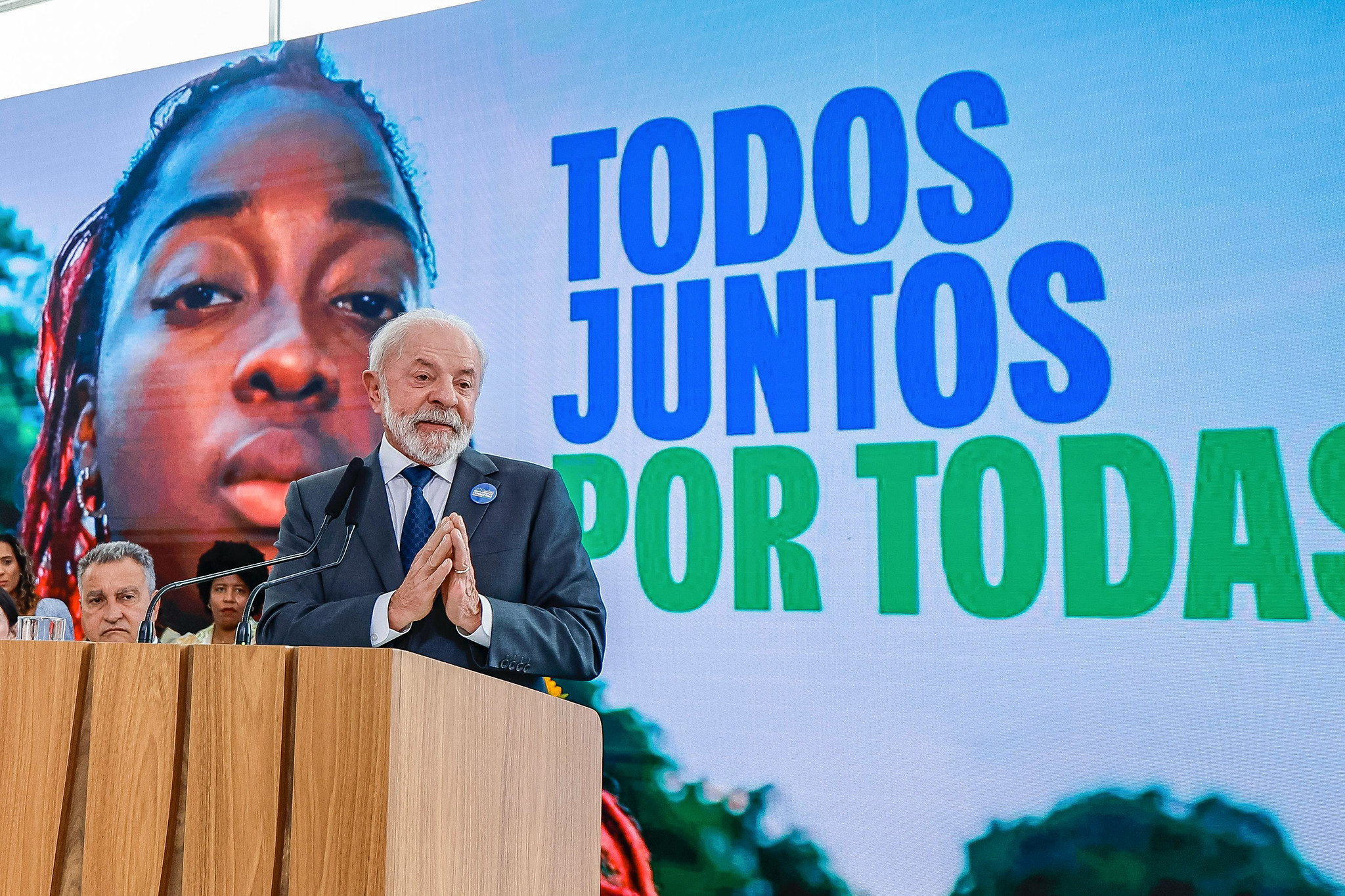
Brazil’s federal government, National Congress and judiciary launched on Wednesday (4) the National Pact Brazil Against Femicide, a joint initiative designed to prevent the killing of women and girls and strengthen coordinated responses to gender-based violence. The ceremony took place at the presidential Planalto Palace in Brasília and included Supreme Federal Court (STF) president Edson Fachin, Chamber of Deputies speaker Hugo Motta and Senate president Davi Alcolumbre, alongside President Luiz Inácio Lula da Silva.
The opening remarks were delivered by First Lady Rosângela “Janja” Silva, who conceived the initiative. As she spoke, the names of women killed in femicide cases were projected on a screen behind her. Janja began with a personal narrative describing a situation of violence that she later revealed could represent the story of any woman present.
“The cycle of violence against women and femicide has become normalized in our society,” she said. “The banalization of women’s bodies, bloodied, mutilated, dragged across asphalt or burned, is unacceptable in a country recognized internationally for its public policies.” She called on men to actively join the struggle against gender-based violence, emphasizing that the pact is “for the lives of women, and also for those whose lives were cut short by femicide.”
Janja thanked President Lula for recognizing the urgency of the issue and committing to make it a shared political struggle. Lula, in turn, acknowledged her role in drawing attention to the severity of violence against women and said the country was entering “a new era” in relations between men and women.
“Right now, while we sign this pact, a woman is being assaulted,” Lula said, listing forms of abuse ranging from physical violence to psychological aggression. According to the president, four women are victims of femicide every day in Brazil.
He stressed that society can no longer remain silent or treat domestic violence as a private matter. “We cannot stay silent, we cannot pretend this has nothing to do with us. People used to say that outsiders should not intervene in domestic conflicts, but we will step in. We won’t look the other way,” he said.
Lula also criticized the role of digital platforms in amplifying misogynistic content and teaching young boys to hate women. “Digital networks cannot continue to be used by criminals who groom girls, commit abuse and drive them toward self-harm and suicide,” he said, calling for greater accountability.
“We need women to feel protected, free and safe, online, at home, on the streets, at work, everywhere and at all times,” he added. “We were made for love, not for hate; for joy, not fear. The responsibility is ours.”
Coordination among state institutions
Supreme Court president Edson Fachin described the initiative as a “pact in defense of life” and one of the most urgent joint actions ever taken by Brazil’s state institutions. He emphasized that femicide represents a severe human rights violation and that legal reforms alone are insufficient without broader cultural change.
“The numbers are shocking: women and girls are killed simply because of their gender,” Fachin said, adding that the judiciary must accelerate trials while ensuring prevention and protection measures.
Senate president Davi Alcolumbre pledged to keep the fight against femicide at the center of legislative debates, while Chamber of Deputies speaker Hugo Motta acknowledged delays in parliament’s response and said the initiative would mark a turning point.
Interinstitutional management committee
According to the government, four women are killed by femicide every 24 hours in Brazil. In 2025 alone, the Brazilian judiciary handled 15,453 cases — an average of 42 per day — representing a 17% increase compared to the previous year. Courts also issued more than 621,000 protective measures during the same period.
To oversee implementation, a decree created an Interinstitutional Management Committee coordinated by the presidency, bringing together representatives from all three branches of government alongside public prosecutors and public defenders. The group will monitor policies, ensure transparency and track outcomes.
Institutional Relations minister Gleisi Hoffmann said the committee will develop a common work plan with priority actions and include participation from civil society organizations, social movements, academia and international institutions.
“The goal is to break the cycle that leads from violence to femicide,” she said, emphasizing the need for deep social change, especially in the education of boys and the responsibility of men to challenge violent cultural norms.
What changes for women?
The pact aims to accelerate the implementation of protective measures, reducing the time between reporting violence and receiving effective protection. Greater data sharing among institutions is expected to prevent gaps in victim support and improve coordination between police, courts and social services.
The initiative also targets digital violence, promotes prevention campaigns and focuses on groups facing higher risk, including Black women, Indigenous women, quilombola communities and people with disabilities.
Communication efforts include the campaign “All together for all women,” encouraging society, especially men, to take part in confronting gender-based violence.
More information is available at TodosPorTodas.br, while the national hotline Ligue 180 remains the primary reporting channel, averaging 425 daily cases last year.