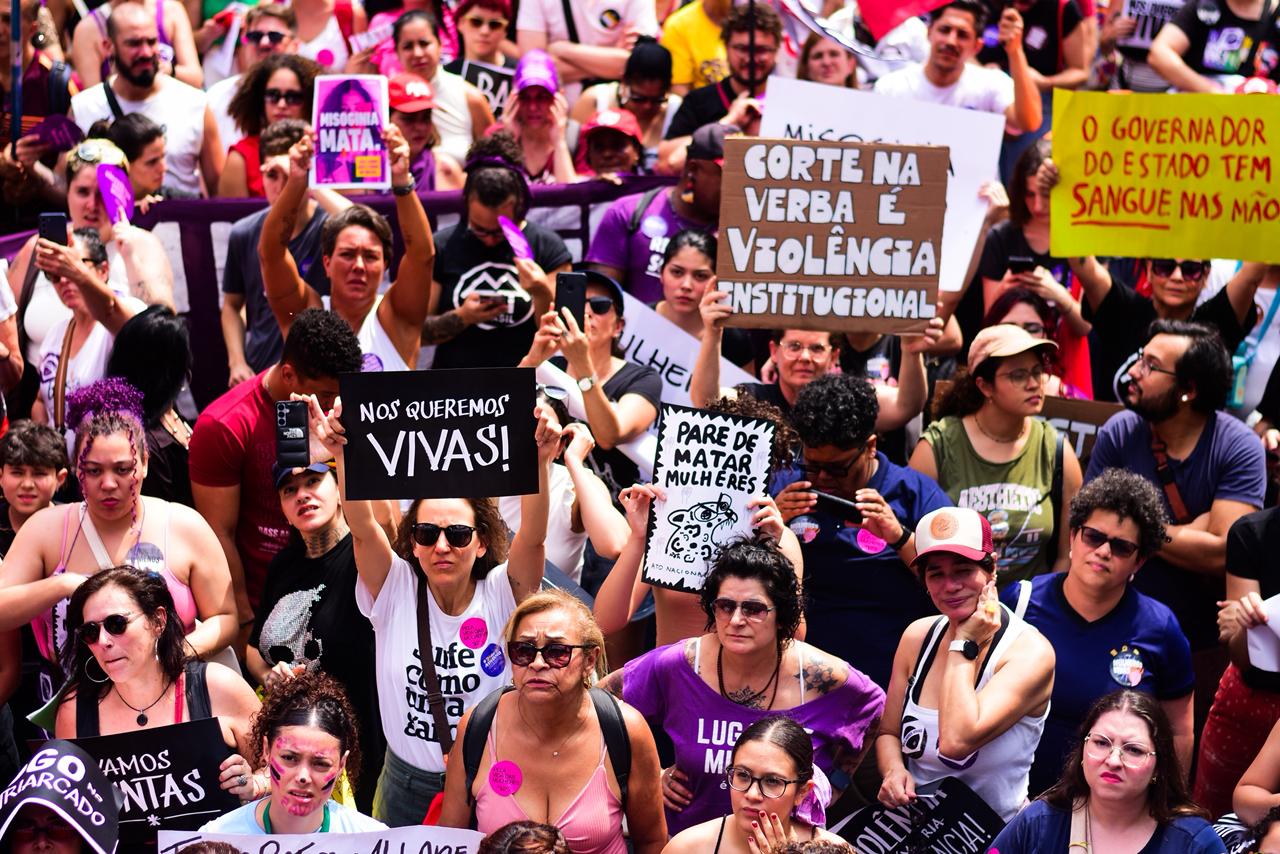
Thousands of women filled the streets of São Paulo on Sunday (7) to demand an end to the epidemic of gender-based killings in Brazil, where at least four women are murdered every day, most of them young, Black, and killed by men they know. The march, part of the national mobilization Women Alive, denounced what organizers call a lethal combination of state negligence, misogynistic culture, and political discourse that devalues women’s lives.
The rally gathered in front of the São Paulo Museum of Art (Masp), where a long banner of names of murdered women was unfurled and demonstrators lay down on the pavement in silence, a collective act of mourning and rage. Survivors and mothers of victims took the microphone to remember daughters, sisters and friends whose deaths exemplify systemic failure. “Every time a woman is killed, I relive my daughter’s death,” said Aletheia Santos, whose 19-year-old daughter Micaelly was murdered by an ex-partner.
Recent cases, including women burned alive, stabbed to death in their sleep, dragged by cars along highways, murdered with their children inside their homes, or killed during routine activities like going to school, fueled the urgency behind the demonstrations. Activists stressed that these crimes are not isolated tragedies, but the visible result of a state that does not ensure safety, response, or protection.
Despite stricter sentencing laws, Brazil recorded a record 1,492 femicides in 2024, according to the Brazilian Public Security Yearbook, the highest number since the crime was legally defined in 2015. Nearly 64% of victims were Black women, and 8 in 10 were killed inside their own homes by partners or ex-partners. The UN reports that worldwide, a woman is killed every 10 minutes by a partner or family member, showing a global crisis reflected starkly in Brazil.
Speakers emphasized the need for structural policies, not only punishment after violence occurs. Feminist organizations demand 24-hour women’s police stations in all cities, guaranteed funding for shelters and emergency housing, specialized public workers, and nationwide education and prevention programs. They also call for accountability of digital platforms that profit from misogyny, arguing that online hate escalates into real-world violence.
The protest also targeted political leaders accused of abandoning the issue. In São Paulo state, demonstrators criticized conservative Governor Tarcísio de Freitas for allocating just R$10 (US$2) in the 2026 budget toward institutional support for vulnerable women, a symbolic figure activists see as evidence of institutional disregard. Even basic guarantees such as legal abortion services, required in cases of rape or risk to life, have been undermined by the state government.
Another central message was directed at men: that they must abandon silence and complicity, and take active responsibility in preventing violence. “If every woman has faced harassment but no man says he has seen or done anything, the math doesn’t add up,” said biologist Camila Postal. “Men have to be part of the solution.”
Marches took place simultaneously in more than 20 cities, including Rio de Janeiro, Brasília, Belém, and Manaus, with more mobilizations scheduled in the coming days. The demonstrations marked a demand for political accountability ahead of Brazil’s 2026 elections, and a united refusal to treat femicide as inevitable.
The message printed on signs, shouted in chants, painted on bodies, and carried through tears, grief, and anger was the same everywhere: “Stop killing us.”