

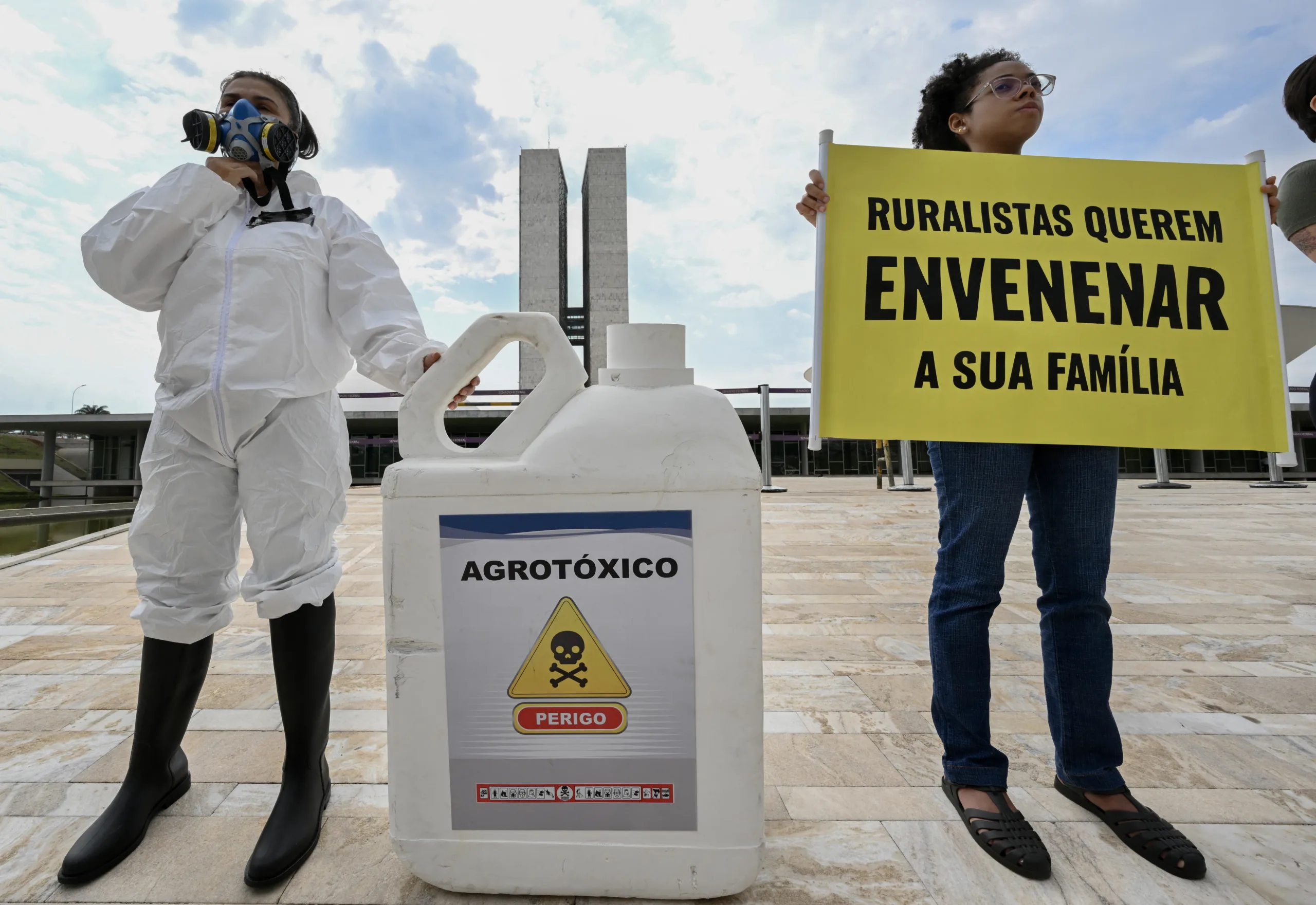
While European countries tighten their domestic regulations and ban numerous agricultural chemicals, they continue to manufacture and export pesticides deemed highly dangerous to public health and the environment. The revelation comes from a report by the NGO Public Eye and Unearthed, the investigative journalism project funded by Greenpeace UK.
In 2024, European Union (EU) member states approved the export of nearly 122,000 tons of pesticides banned for use within their own farms, a 50% increase compared to the 81,000 tons reported in 2018.
In terms of products, 75 pesticides banned in Europe to protect human health and the environment were authorized for export in 2024, almost double the 41 products exported in 2018.
Altogether, EU-banned pesticide exports were sent to 93 different countries last year; 75% of them were low- and middle-income nations, where environmental and health regulations are typically weaker. The United States was the largest importer, followed by Brazil, now the world’s biggest pesticide market.
“As we say in Brazil, it’s a double standard: what’s banned for me, I export to you,” said researcher Larissa Bombardi, author of Pesticides and Chemical Colonialism. She attributes the sharp rise in exports to the powerful lobbying of the chemical industry across Europe.
“France was the first country to announce a ban on the production, storage, and export of substances prohibited in Europe,” Bombardi explained. “But in practice, it still happens. Industry lobbying was massive. During the parliamentary debate, corporations pushed hard, arguing that Europe would lose its global economic relevance if restrictions were enforced.”
Bombardi notes that the situation is worsening:
“Each year I track these figures, the share of EU-banned pesticides among Brazil’s ten best-selling agrochemicals keeps growing. When I started, it was three out of ten, now it’s seven.”
Unfulfilled promises
In October 2020, the European Commission pledged to ‘set an example’ by ending the export of banned pesticides as part of its European Green Deal and new chemical strategy.
According to Alan Tygel, of the Permanent Campaign Against Pesticides and for Life, Europe once symbolized a “civilizational horizon” by restricting toxic chemicals. But, he says, the recent rise of right-wing and far-right forces has revived Europe’s colonial posture.
“The increase in EU exports of banned pesticides to Brazil and the Global South is no surprise,” Tygel said. “It reflects a Europe driven by profit at any cost, exploiting the lives and lands of the Global South, especially Brazil.”
Tygel recalled that Brazil’s pesticide approval system used to rely on a tripartite review involving the environmental agency (IBAMA), the health agency (ANVISA), and the Ministry of Agriculture (MAPA). But legislative changes have weakened regulators and concentrated power in MAPA, dominated by agribusiness lobbies.
“Over the past 20 years, pesticide use, planted area, and corporate profits have grown nonstop, about 8% annually. Nothing else in Brazil’s economy grows like that: not inflation, GDP, or banking profits. Only the pesticide market.”
Colonial mediocrity
According to Diego Moreira of Brazil’s Landless Workers’ Movement (MST), this reflects “the mediocrity” of the Global North and the submissiveness of the Global South. “We are poisoning our soil, our water, and our people, for what? For profit that serves a handful of elites,” he said.
“There’s also a deeper mediocrity within Brazil’s own elite, a bourgeoisie willing to play the role of Europe’s dump,” he added. “We must reject being treated as the landfill of colonial powers.”
Chemical colonialism
Bombardi connects Europe’s chemical trade practices to historical colonial structures linking Europe and Latin America. “Brazil occupies a historically subordinate position rooted in colonialism. Europe’s continued export of toxic chemicals, and Brazil’s acceptance of them, reflect this colonial legacy,” she said.
She identifies a “pernicious triad” that defines Brazil’s social and territorial formation. “The enslavement of human beings, absolute land control by a white elite, and the genocide of Indigenous peoples, that’s not our past; it’s our ongoing reality.”
Bombardi stresses the need for land reform and democratized access to land, noting that “1% of landowners still control 50% of Brazil’s territory.”
“Brazil must wake up and say: ‘We want food sovereignty and a new social pact, not subordination.’”
The poisons have names
EU exports of banned agrochemicals to Brazil totaled 14,643,565 kilograms/liters, including Mancozeb, Atrazine, Cyanamide, Thiram, Thiamethoxam, Cyproconazole, Dimethoate, Thiophanate-methyl, and Propargite.
Major shipments included Glufosinate, with over 2 million kg/l, produced in Germany; Picoxystrobin, with 5 million kg/l, produced in Belgium, Spain, France, and Hungary; Epoxiconazole, with 2.47 million kg/l, produced in Germany; and Fipronil, with 1.46 million kg/l, produced in Germany, Denmark, and France.
“It’s alarming, these are substances banned in Europe,” Bombardi warned, stressing something that should be — but isn’t — obvious: “Those substances are banned here exactly because of their severe impacts on human and environmental health.”
“Atrazine, for instance, is linked to cancers of the stomach, prostate, thyroid, and ovaries, as well as Parkinson’s disease, infertility, fetal malformation, and liver cell damage. Its use in the Brazilian Amazon has increased by 575% in the last decade — and it easily contaminates water.”
She also highlighted neonicotinoid pesticides, banned in the EU for decimating pollinators essential to biodiversity and food production. “Brazil has become the top destination for these neonicotinoids,” she noted. “This means a serious risk of biodiversity loss and future declines in agricultural productivity.”
And what about Lula?
In September 2024, during a meeting on wildfires, President Luiz Inácio Lula da Silva called for “the ban of the banned.”
“It’s unacceptable that 80% of the pesticides banned in Germany are freely sold in Brazil, as if we were a banana republic,” Lula said.
Alan Tygel also recalled that, in July this year, Brazil’s social and environmental movements achieved a partial victory with the launch of the National Program for the Reduction of Pesticides (Pronara) by the federal government, after successive postponements caused by pressure from agribusiness and the refusal of the Ministry of Agriculture (Mapa) to join the plan. The program is part of the National Plan for Agroecology and Organic Production (Planapo) and the National Policy for Agroecology and Organic Production (Pnapo), and has been the subject of internal disputes within the government.
“We are now demanding and building the Pronara we want,” said the activist. “That means creating pesticide-free zones, ending aerial spraying, ensuring inspection of drones that today spread poison with impunity, ending the chemical warfare that uses pesticides to expel traditional communities, and protecting Indigenous communities that are, in many places, facing a state of calamity due to pesticides.”
For Larissa Bombardi, at a time when Brazil is discussing and promoting the defense of its sovereignty, and on the eve of hosting a United Nations Climate Change Conference (COP30) in Belém (Pará), the debate on pesticides must be brought to the forefront.
“COP should be a space for us to understand that pesticides are directly related to climate change, that the very industrial production of pesticides involves significant use of fossil fuels, and that the substances that make up these pesticides also originate from them. I think COP is an incredible opportunity for us to discuss this,” she said.
What do the authorities say?
BdF reached out to Brazil’s Ministry of the Environment (MMA), MAPA, Ibama, and Anvisa.
Only the MMA responded, stating that it “supports stricter control over hazardous substances and the promotion of environmentally responsible agricultural models.”
The ministry also cited Brazil’s participation in international frameworks such as the Highly Hazardous Pesticides Alliance, and the Stockholm, Rotterdam, and Basel Conventions, and reaffirmed its work on Pronara and the National Policy on Agroecology and Organic Production (Pnapo).
It emphasized that pesticide registration is shared among Mapa, Anvisa, and Ibama, but that under the new Law 14.785/2023, Mapa holds the authority to grant approvals, while Anvisa and Ibama remain responsible for toxicological and environmental risk analyses.
“The MMA advocates strengthening these mechanisms, ensuring that science continues to guide regulatory decisions and environmental protection,” the statement concluded.

