

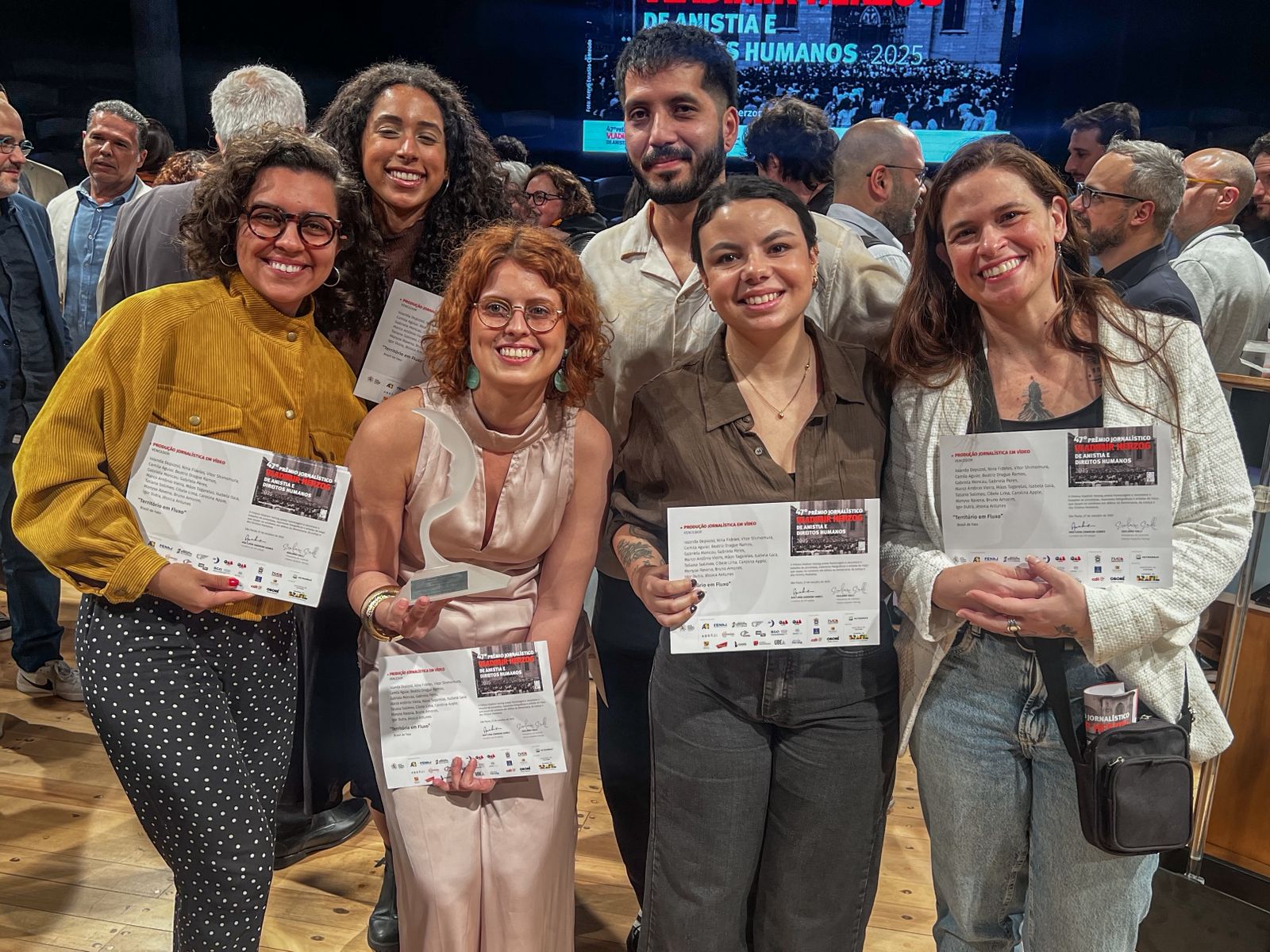
On Monday night (27), the team behind the documentary Território em Fluxo (Territory in Flux), a production by BdF, attended the 47th Vladimir Herzog Journalism Award for Amnesty and Human Rights ceremony at the Tucarena theater in São Paulo (SP). The prize is considered the most important recognition in Brazilian journalism.
The award-winning documentary series, winner in the Video category, is organized into five episodes and is available on BdF’s YouTube channel with English subtitles.
Nina Fideles, executive director of BdF, celebrated the recognition, which she said “reminds us why we do journalism.” “It’s a daily choice […] permeated by a lot of passion, indignation, a deep desire to tell stories, a strong connection to truth, much commitment and engagement,” she said while receiving the trophy.
The result of nine months of reporting, the series seeks to break with stigmatizing approaches to the territory known as Cracolândia, central area known for open-air crack use, focusing instead on care and the right to the city. The five episodes — The Flux, Housing, Public Security, Health and Care, Art and Culture — highlight everyday practices of resistance and alternatives to drug-war policies, bringing forward the voices of those who live and work there.
“I’m inspired by the stories shared here today,” Fideles concluded. “Thank you for resisting, thank you for taking a stand. I thank all of you, not only journalists, but everyone who has suffered state crimes and other forms of violence we seek to denounce.”
‘We realized there was a lot of life there’
Before the awards ceremony, representatives of the winning projects participated in the 14th Roundtable with Winners, a space for guests to discuss the behind-the-scenes work. According to the Vladimir Herzog Institute, this is a pioneering initiative in the history of Brazilian journalism contests.
During the conversation, BdF journalist Beatriz Drague Ramos, part of the Território em Fluxo team, spoke about the early stages of research on Cracolândia.
“We wanted to better understand what was happening with the harm-reduction policy that had been dismantled in 2017 by Doria,” she explained. “We wanted to know where that policy went and came across the work of local collectives, who are there daily providing affection and care. We realized they are carrying out the very harm-reduction work that was extinguished by Governor João Doria.”
Before filming, the BdF team spent nearly two months following these collectives and establishing relationships with future interviewees.
“We wanted to understand how people ended up there, why they are there, and how that territory became marginalized […] We realized there is a lot of life there, largely because of the people who are there every day, looking at others’ humanity,” Ramos said.
Território em Fluxo competed against “Cuidados Paliativos: vida até o último dia de vida,” from TV Globo’s Fantástico, and “Mães de luta,” from TV Brasil.
Democracy and human rights
During the ceremony, Ivo Herzog, son of Vladimir Herzog, journalist murdered during Brazil’s military dictatorship, emphasized the importance of journalism in defending democracy and human rights. “It is the power that oversees the other three powers. It is the power that allows a nation to remain sovereign, remain democratic, respect its citizens, and treat them with dignity,” he said.
This year, the Award received 485 submissions: 168 in text; 58 in video; 26 in audio; 39 in multimedia; 40 in photography; 18 in art; and 168 in book-reporting. A group of 58 invited jurors selected the finalists. In a Public Judgment Sesion held on October 7, the Organizing Committee chose the winners in eight categories.
Marking the 50th anniversary of Vladimir Herzog’s assassination, the organizers created a new category: Defense of Democracy. The goal is to highlight coverage of national politics, attacks on the democratic rule of law, and how Brazilian institutions at all levels are defending democracy. A total of 120 submissions competed.
About the award
Created in 1979, the Award honors the journalist who was killed by the civil-military dictatorship on October 25, 1975, inside the DOI-CODI torture center in São Paulo. Since then, it has recognized journalism that contributes to the promotion of fundamental human rights.
As of 2023, the prize has been organized by the Vladimir Herzog Award Institute, founded in November 2022. The institution consists of 18 civil-society organizations and the Herzog family, with support from universities, collectives, unions, and other entities.
