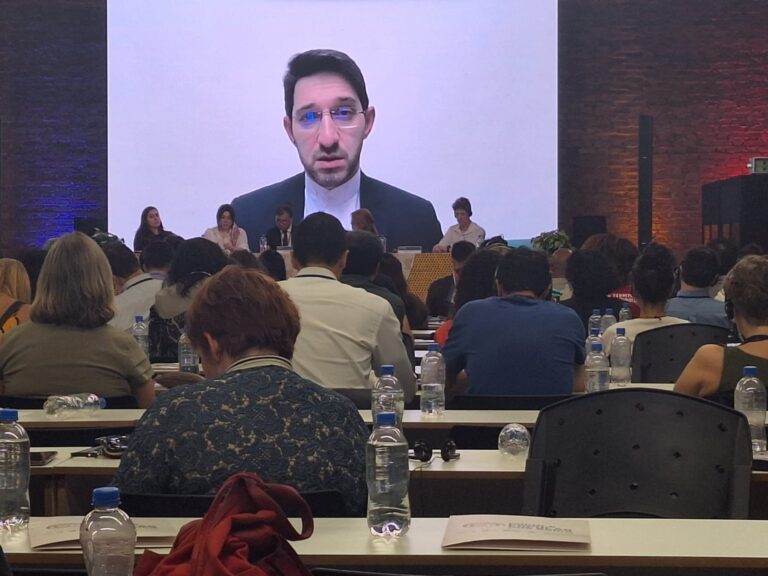
The first People’s Brics Summit is debating how civil societies from member countries can influence public policies adopted by their governments. On Tuesday (2), thematic working groups of the Brics Civil Council presented their conclusions and recommendations in the areas of Health, Education, Ecology, Culture, Finance, and Artificial Intelligence.
Health
Celia Medina, from the Brazilian Center for Solidarity with the Peoples and the Struggle for Peace, said that the main challenge is developing policies capable of responding to the diverse realities and needs across Brics countries. She emphasized that governmental funding mechanisms and intergovernmental committees must play a central role. “Strengthening public health systems, primary care, improving information systems, and creating an observatory are key. Success depends on the ethical commitment of governments,” said Medina.
Natalia Bondarenko, director of Russia’s Federal Clinical Hospital No. 85, added that mental health must be a priority in any cooperation strategy. “No state is strong if its people are not well mentally,” she said, highlighting the need for emotional education in schools, anti-stigma campaigns, telemedicine, rehabilitation programs, and protection for victims of violence.
She stressed that international cooperation is essential and echoed a well-known proverb: “If you want to go fast, go alone. If you want to go far, go together.”
Education, Ecology and Culture
Representing the Education working group, South African delegate Margaret Molefe called for deeper cooperation in science and digital technologies, including artificial intelligence, through partnerships between governments, academia and civil society. “We must recognize informal knowledge and mutually accept degrees and certifications. Harmonizing regulations will help remove educational barriers.”
On behalf of the Ecology working group, Maria Beatriz, from the Brics Socio-Environmental Platform, highlighted the urgency of building climate justice and popular sustainable development in the Global South. “We must base our agenda on principles such as environmental disaster prevention, polluter-pays responsibility, common but differentiated responsibilities, intergenerational solidarity, public participation, and sustainable development.”
The group also called for recognition of forest communities as key actors in ecological transformation, accountability mechanisms for polluters, and support for workers transitioning out of polluting industries. She concluded by stressing the need for coordinated action: “Ecology must be treated together with all other BRICS agendas.”
Presenting on behalf of the Culture working group, Sérgio Cohn, president of the Brics Arts Association, argued: “Art brings people together, fostering friendship, cooperation, and a fairer world.”
Finance and Artificial Intelligence
Economist Samuel André Spellmann, professor at the Federal University of Pará (UFPA), presented recommendations from the Finance working group, aiming to expand multilateral credit, implement new lending standards, and develop a Brics grain basket proposed by Russia to strengthen food security and reduce dependence on the U.S. dollar in trade.
He also defended “a fairer system of interest rates, a Brics platform for financing green technologies, incentives for innovation through startups, and reducing technological asymmetries within the bloc.”
The group called for greater use of national currencies in trade among Brics countries to reinforce sovereignty and balanced economic relations.
Finally, Irina Kostetskaya, deputy director of the Russian Infrasvyaz Foundation, presented the recommendations for Artificial Intelligence. She noted that Brics members are at very different technological stages: China is highly advanced, Brazil, Russia, India, and Indonesia are at an intermediate level, while Egypt, Iran, South Africa, and Ethiopia face significant technological gaps.
“AI development is impossible without addressing infrastructure issues such as broadband internet and data centers. Digital literacy is fundamental to ensuring that these technologies benefit entire populations, not only an urban elite,” she concluded.