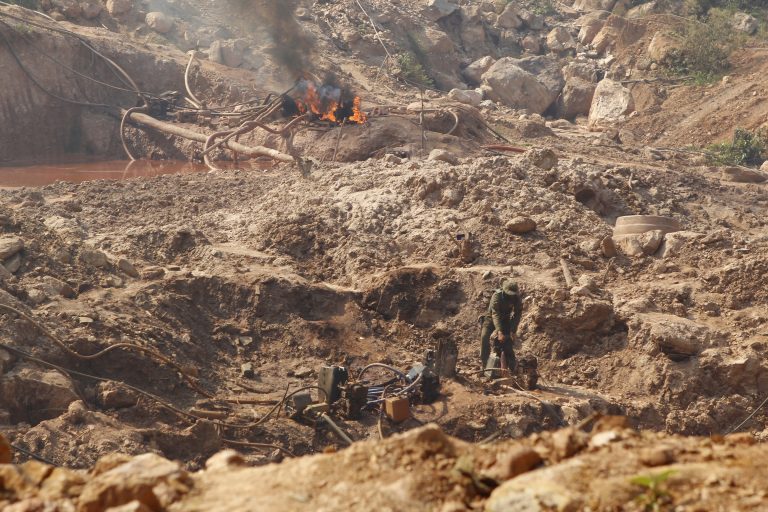

Two mining sites operated by Vale in the city of Congonhas, in the Brazilian state of Minas Gerais, suffered spills less than 24 hours apart between Sunday (25) and Monday (26). The city is located about 80 kilometers from Belo Horizonte, the state capital. More than 260,000 cubic meters of sludge were released, according to local authorities. While no casualties were reported, officials warned of significant environmental damage.
The two affected mines are about 22 kilometers apart. The first spill, on Sunday, occurred at a structure known as Fábrica. Mining waste containing ore and other materials flowed into the Goiabeiras River, which runs through the city’s urban area.
A second spill was confirmed on Monday at the mine known as Viga. Brazil’s Civil Defense reported that water overflowed into the Maranhão River, located in the same region.
In a statement, Congonhas’ Municipal Department of Environment and Climate Change said the incidents have caused biodiversity loss and a decline in water quality.
“These impacts will be observed over the coming months, as this material continues to move downstream,” said municipal environment secretary João Lobo. “In areas closer to the rupture at Vale’s Fábrica mine, we have seen trees and rocks being dragged along and changes in the river’s course,” he added.
Vale said in a statement that the spills were identified and contained. The company claims there was no release of mining tailings, only water mixed with sediment. “Neither incident is related to Vale’s dams in the region, which remain stable and safe and are monitored 24 hours a day, seven days a week,” the company said.
The waters of both affected rivers, the Goiabeiras and the Maranhão, flow into the Paraopeba River. The Paraopeba was also contaminated by Vale’s Brumadinho dam collapse on January 25, 2019, a disaster that killed 272 people and became one of the deadliest mining crimes in Brazil’s history.
The grim coincidence, the Congonhas spill occurred exactly seven years after the Brumadinho disaster, was highlighted by biologist Luiz Paulo Siqueira, director of the Movement for Popular Sovereignty in Mining (MAM), in an interview with Radio BdF.
“What we see is a scenario that repeats itself over and over, especially during the rainy season, when a series of tragedies and acts of irresponsibility by mining companies begin to occur,” Siqueira said. “These incidents happen repeatedly, and what does the company do? It blames the rain, outsourcing responsibility to the environment itself. That is an affront to Brazilian society as a whole, especially here in Minas Gerais, where people are constantly living with mining-related disasters.”
Siqueira stressed that riverside communities that depend directly on these waterways are already feeling the first impacts. However, he warned that the deterioration of water quality affects the entire region. According to him, cases like this continue to occur without meaningful change, even after tragedies such as Brumadinho.
“The real commitment is always the same: maximizing mining profits through the extraction of our mineral wealth, while leaving behind a trail of destruction for the Brazilian people,” he said.
With information from Agência Brasil